
Every greenkeeper has seen a green with sand stripes that you can spot from the tee: thicker bands, parallel grooves or little piles at the end of each pass. Almost always the culprit is a poorly adjusted topdresser or material that was not right for that day.
In this article we review five specific adjustments so your topdresser spreads sand properly. You will see what to check before starting, how to calibrate, what role speed and brushing play, and what maintenance the machine needs to repeat the result pass after pass.
Topdresser adjustment 1: dry, uniform material
No topdresser works well with wet or poorly graded sand. The material matters as much as the machine in the final result, and it should be checked before touching any control.
- Store sand under cover in a ventilated place so it reaches the hopper dry.
- Check that the material meets the particle size specified for the task, with no lumps or fines that cake together.
- If it is damp, let it dry or adjust the timing of the job: forcing wet sand blocks the outlet and leaves an uneven spread.
- Try to use the same batch across the whole green; mixing different sands changes how it behaves in the soil.
A good habit is to test flow with a handful: if it clumps when squeezed, it is not ready to go through the machine.
Adjustment 2: calibrate the rate before heading out to the course
Calibrating a topdresser is as important as calibrating a sprayer. The rate depends on the gate opening, the speed of the belt or roller and the forward speed. If one of the three changes, the result changes.
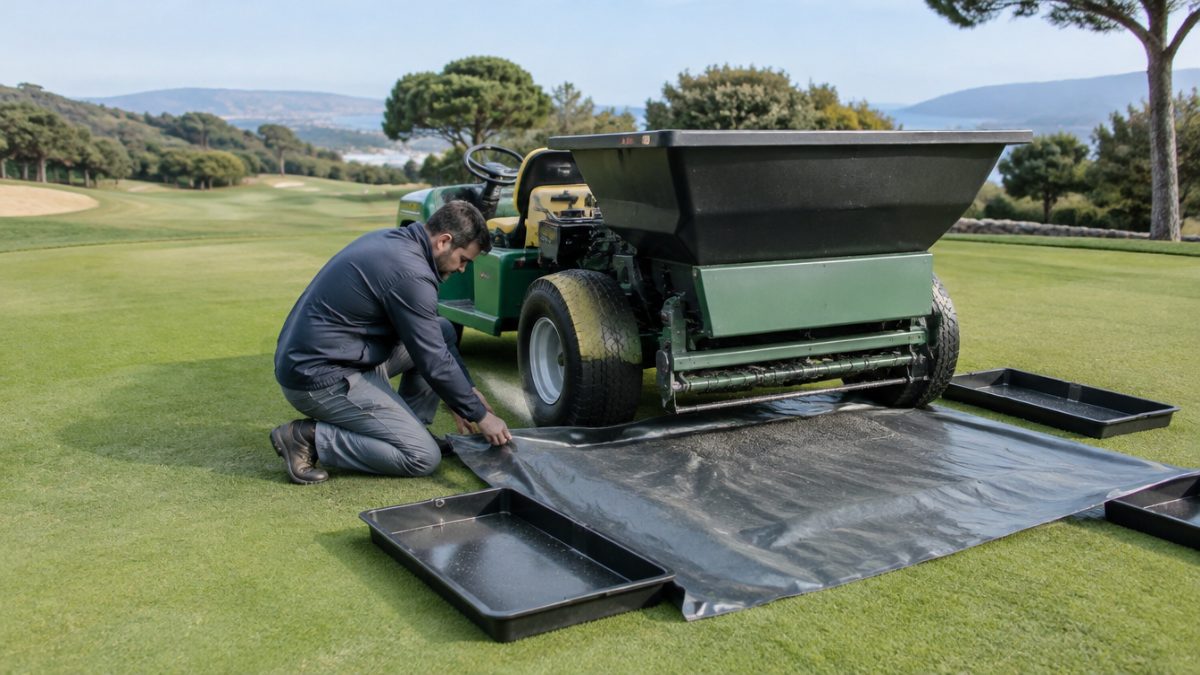
- Lay out a tarp or several trays on a flat surface.
- Make a pass at the planned speed and opening.
- Weigh what was collected over a known area and calculate the application per square metre.
- Adjust the opening until you reach the target rate and repeat the test.
Note down the combination of settings that works with each type of sand. That way you do not have to start from scratch every time the operator or the season changes. As a rough guide, light, frequent topdressings cover better than a few heavy layers.
Adjustment 3: constant forward speed
Speed is the adjustment most often neglected. A topdresser that accelerates on the straight and slows in the turn deposits more sand at the end of the pass and leaves those infamous little piles. Ideally the operator keeps a steady speed and the machine stops delivering material before turning.
- Define a standard working speed and mark it for the whole team.
- Avoid sudden starts and stops with a loaded hopper.
- Close the gate or stop the belt before turns if the model allows it.
- Plan pass patterns that avoid overlaps, for example parallel with a slight, controlled cross-over.
The terrain also matters: on a green with a steep slope, going up and down with a loaded topdresser changes the spread. In those cases, work in the most favourable direction and reduce the hopper load.
Adjustment 4: brushing and irrigation afterwards
Spreading with the topdresser is only the first half of the job: the sand has to get down to the soil and not stay on the leaf. Correct brushing, with equipment and intensity suited to the condition of the turf, helps work it into the base and level out small irregularities.
- Brush when the leaf is dry, or the sand will stick and be dragged.
- Adjust the pressure so as not to damage the stem or tear out stolons.
- Irrigate lightly afterwards to settle the sand and prevent wind or the next mowing from displacing it.
- Adjust the cutting height for the next mowing so as not to dull the cylinders with loose sand.
It pays to coordinate the job with rolling and subsequent mowings, so that the course does not lose speed or tidiness for longer than necessary.
Choose the timing and frequency of the job well
Not even the best adjustment makes up for a badly chosen date. Topdressing works best when the turf is growing vigorously, because the leaf rises and covers the sand within a few days. On bermudagrass and other warm-season species, this usually coincides with spring and summer; on cool-season grasses, with autumn and spring. In the middle of heat stress or with dormant turf, recovery is slow and the surface stays marked for longer.
- Schedule passes well away from tournaments or major events, leaving time to recover.
- Prefer light, frequent applications to thick layers that smother the leaf.
- Check the forecast: wind and heavy rain ruin a job done well.
- Tell the pro shop and players that speed will be lower that day.
Recording dates, rates and conditions for each topdressing lets you compare results between seasons and fine-tune the strategy.
Adjustment 5: keep the topdresser as a precision machine
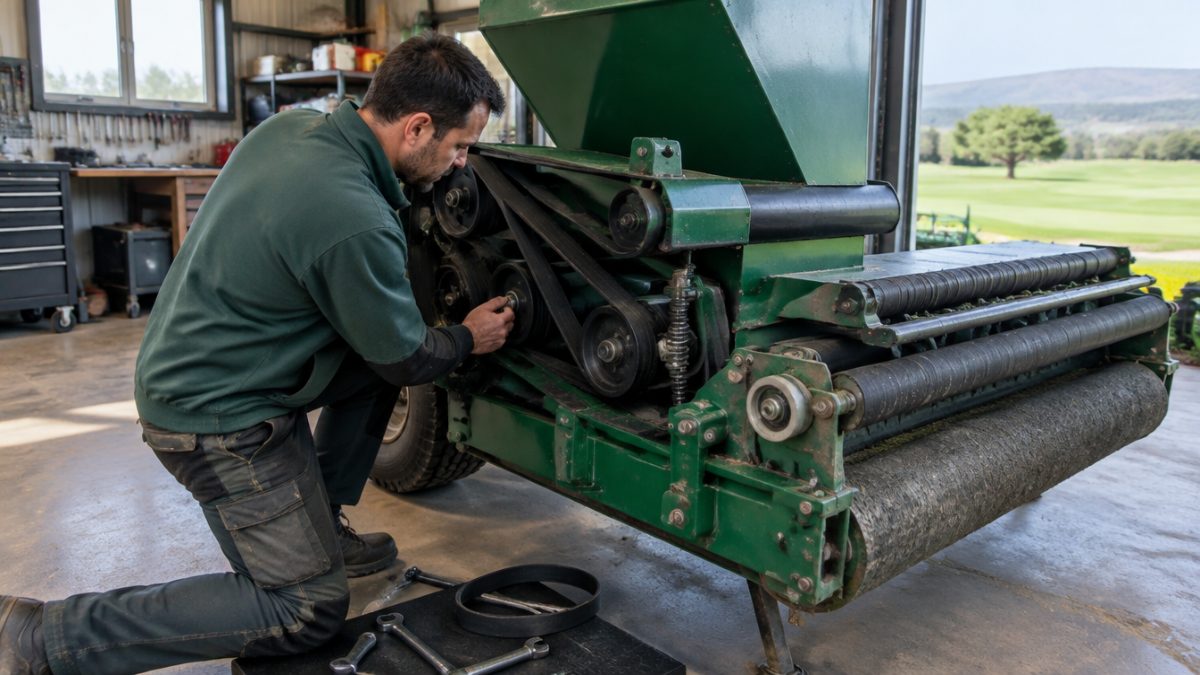
Sand is abrasive. Belts, rollers, bearings and chains suffer more than it seems, and even slight wear makes uniformity worse. That is why the topdresser should be included in the machine’s service record and in the preventive maintenance plan.
- Clean the hopper and mechanisms at the end of each day, especially if moisture has been left behind.
- Check tension and condition of belts, rollers and brushes periodically.
- Grease the points indicated by the manufacturer and note dates and hours of use.
- Check tyre pressure and condition, because they affect the regularity of travel.
- Store the machine clean, dry and covered.
A simple inspection log lets you anticipate the replacement of wear parts before they ruin an important job, such as topdressing ahead of a tournament.
Further reading: USGA. The USGA publishes general recommendations on materials and topdressing practices for greens that serve as a technical reference.
Frequently asked questions
Why does the topdresser leave bands on the green?
The most common causes are a poorly calibrated gate, worn belts or rollers, uneven forward speed or damp sand that flows badly. Overlaps between passes also play a part. To fix it, check the material, recalibrate the topdresser over a tarp and set a constant working speed for all operators.
How often does the topdresser need to be calibrated?
As a rough guide, at the start of each topdressing season, whenever you change sand and any time you replace a part that affects metering. It is also advisable to repeat the check if the result on the course does not match what was expected. Noting the correct settings for each material makes later work much easier.
What basic maintenance does a topdresser need?
Cleaning the hopper and mechanisms after each use, checking belts, rollers and brushes, greasing as the manufacturer indicates and monitoring tyres. Sand wears many parts, so recording hours and inspections helps predict breakdowns. A well-kept topdresser spreads more evenly and lasts longer.
Keep reading
- Thatch in greens: how to control it Thatch in greens: 6 warning signs and how to reduce it
- Preventive maintenance of machinery Preventive Equipment Maintenance: 7 Key Tasks
- Rolling greens: when and how Rolling Greens: 5 Benefits for Green Speed