

When a greenkeeper hears about STRI, they usually think of visit reports, grass seed variety trials or green speed measurements. That makes sense: this British institute, dedicated to the study of and consultancy on sports turf, has for decades influenced how the quality of a playing surface is evaluated and explained.
You do not need to be in the United Kingdom to benefit from its approach. In this article we review five contributions from STRI that you can bring to your Mediterranean course with judgement, adapting whatever makes sense to your climate, your species and your budget.
Contribution 1 from STRI: measuring the surface with objective instruments
One of the most useful ideas popularised by British research is that the quality of a surface can be described with numbers and not just impressions. Ball speed, firmness, soil moisture, surface smoothness and grass height are parameters that can be measured repeatably.
Measuring does not replace the expert eye, but it backs it up. When a member complains that the greens are slow, a record of week-by-week measurements completely changes the conversation.
- Always measure at the same points and at the same time of day.
- Note that day’s conditions: weather, mowing, recent operations.
- Compare trends, not isolated values.
Contribution 2: quality standards everyone can understand
Another contribution from STRI is the idea of setting performance standards for each surface: what is expected of a green, a fairway or a tee box in terms of playability, and how it is checked. A well-defined standard lets the greenkeeper, management and players speak the same language.
In practice, this means each course should define its own target quality level, reasonable for its budget and climate, and evaluate it regularly. Not every course needs the same speed or the same firmness; what matters is that the target is clear and achievable.
- Define the expected level for each type of surface.
- Choose the parameters that describe it.
- Set the measurement frequency.
- Review the results with the green committee.
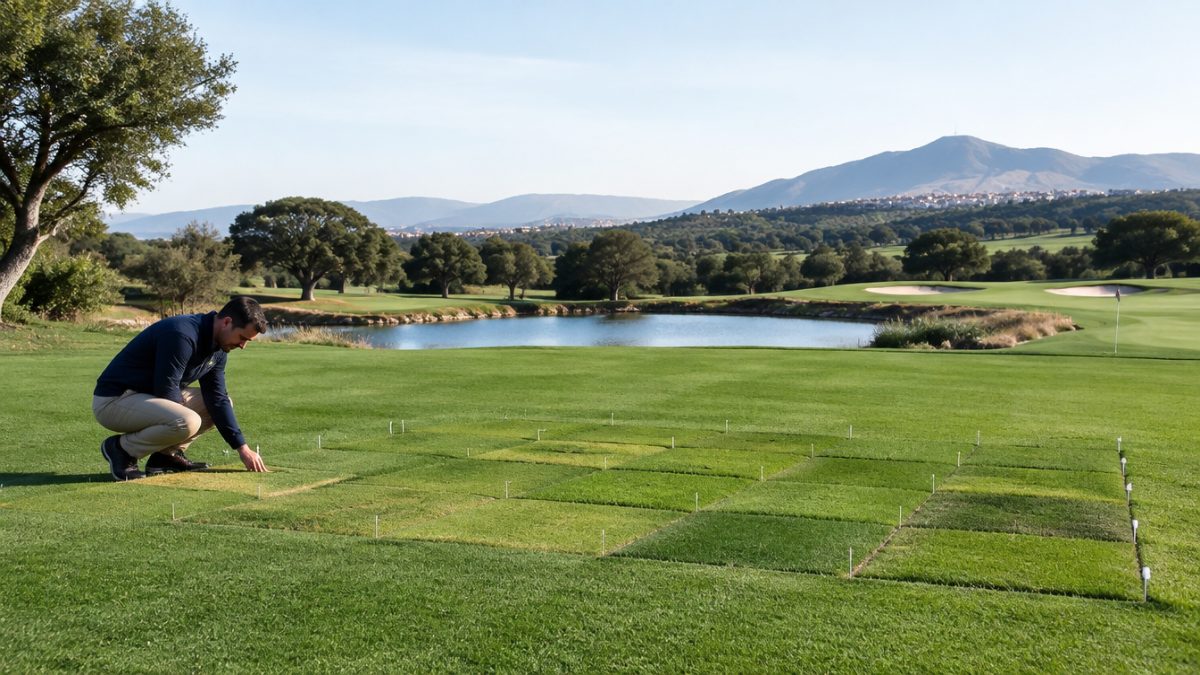
Contribution 3: independent trials of species and varieties
British research has driven comparative trials of turf varieties under controlled conditions, assessing aspects such as density, colour, disease resistance and wear tolerance. For a greenkeeper, these trials are a valuable guide when choosing seed.
That said, the results of a trial are obtained in a particular climate, and ours is very different from the British one. That is why reports should be read with perspective: they help you understand which characteristics matter and how varieties compare, but local adaptation has the last word. In the Mediterranean area, tolerance to heat and drought will be the priority.
- Compare trials with the experience of nearby courses.
- Test new varieties in a small area before rolling them out.
- Record how they perform in your climate over several seasons.
Contribution 4: turf health as a management question
STRI’s studies on turf diseases and problems have reinforced an idea that is now almost a consensus: the health of a surface depends as much on management as on treatments. The combination of leaf wetness, organic matter, compaction, air movement and nutrition explains a good part of the problems that are put down to chance.
Hence many of its recommendations focus on cultural prevention: ventilating shaded areas, controlling thatch, adjusting irrigation and avoiding excess nitrogen. If a pesticide treatment is needed, the label and current regulations must always be followed, with the advice of a licensed technician.
- Prioritise cultural management over chemical intervention.
- Observe and note how things develop before deciding.
- Ask for outside help when the diagnosis is uncertain.

Contribution 5: sustainable management and course planning
STRI also works on designing sustainable management plans: efficient water use, reduced inputs, habitat management and long-term planning. The common lesson is that sustainability is built with data and measurable objectives, not with generic statements.
For a Spanish course, that means knowing water consumption by sector, the use of fertilisers and pesticides, the naturalised area and machinery hours. On that basis you can set realistic goals, compare seasons and communicate progress credibly to members, authorities and neighbours.
- Choose a few indicators and always measure them the same way.
- Set achievable annual goals and review them.
- Communicate the results clearly and regularly.
How to apply STRI's ideas on your course
You do not need to commission an audit to benefit from STRI’s philosophy. Start with the simplest thing: pick three quality parameters, measure them regularly and keep the results. After a few months you will have an objective picture of how your surface responds to each operation, each season and each management decision.
Then expand little by little. The value of the tool is not in the sophistication of the instrument, but in the consistency with which it is used and the honesty with which the results are interpreted.
A practical tip: set aside a fixed day each week for measurements and have the same person always do it, with the same equipment and the same route. It seems a minor detail, but it greatly reduces variability and makes comparisons between weeks, between greens or between seasons truly reliable. If you also keep the data in a single place, you will have plenty of material to justify any decision.
Further reading: STRI. On the STRI website you can find information about its evaluation, research and consultancy services for sports turf.
Frequently asked questions
What is STRI?
STRI is a British institute specialising in research, consultancy and evaluation of sports surfaces, with a particular focus on golf and football turf. Its work ranges from variety trials to quality standards and sustainability advice. Its publications are an international technical reference.
Are STRI's recommendations applicable to the Spanish climate?
The principles are, the specific values not always. Objective measurement, quality standards and cultural management apply anywhere, but species, irrigation and the timing of operations must be adapted to the Mediterranean climate. Always compare STRI's recommendations with local experience.
What parameters does STRI measure on a green?
Typically they assess ball speed, surface firmness, soil moisture, smoothness or consistency of play and mowing height, among others. What matters, as STRI teaches, is to always measure in the same way and analyse the trend over the season.
Keep reading
- The work of the USGA Green Section USGA Green Section: 5 useful resources for greenkeepers
- Green firmness: how to measure and interpret it Green Firmness: 5 Ways to Measure and Improve It
- GCSAA: the golf course superintendents association GCSAA: 5 Ideas from the US Benchmark for Greenkeepers