
Plant growth regulators have become a routine tool on many golf courses: they help slow vertical growth, regulate mowing workload and keep surfaces more uniform. But they also raise doubts, because they only work when applied with judgement and at the right moment.
In this article we review six real benefits, the limits worth knowing and good practice for their use. Every application must follow the product label, current regulations and the advice of a licensed technician; here you will find criteria, not recipes or rates.
What plant growth regulators really do
Their function is to change the plant’s growth rate, above all the elongation of leaves and stems, without killing the turf. In practice, the turf grows more slowly, puts less energy into the above-ground part and tends to gain density in the lower part of the canopy.
It is worth distinguishing between greens, tee boxes, fairways and rough, because the objective changes in each area. On greens the aim is mainly consistency and roll quality; on fairways and rough, fewer clippings and fewer machine hours. Plant growth regulators are not planned the same way in one place as in another, and a single programme does not suit the whole course.
They are neither fertilisers nor fungicides, and they do not replace good management. Their effect depends on the species, temperature, moisture and fertilisation. Understanding this avoids unrealistic expectations: not every course responds the same way, and not every green needs the same thing in the same weeks of the year.
Benefits 1 and 2: fewer clippings and more consistent surfaces
The first obvious benefit is a smaller volume of clippings. Fewer clippings means less collection, less transport and less waste handling, which is especially valuable on large fairways and semi-rough.
That saving is not just time: it also reduces machine wear and fuel or energy use, as long as the programme is well tuned.
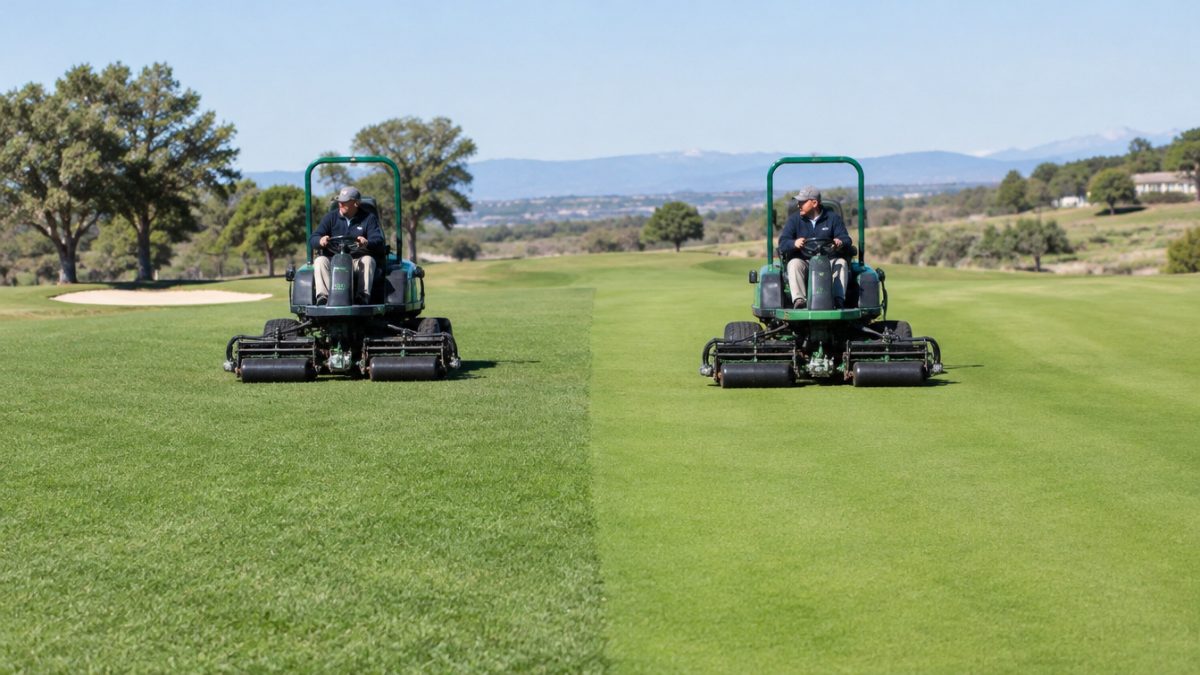
The second is consistency. When growth is slowed in a controlled way, the effective height of the turf between cuts fluctuates less. The golfer perceives a more uniform surface and the mower works with a cleaner cut, provided sharpening and adjustment are correct.
- Fewer growth spikes after fertilising or irrigating.
- Less variation in green speed between consecutive days.
- More stability on heavily trafficked tee boxes and fairways.
Benefits 3 and 4: density, playing quality and saved hours
Many greenkeepers use plant growth regulators to obtain a denser turf, with more tillers per unit area. That density improves the feel of play and can help hold the surface through stress periods, together with a good irrigation and nutrition programme.
The fourth benefit is operational: if the turf grows more slowly, there is room to reorganise mowing hours and devote them to other course tasks, such as edging, bunkers or touch-ups. That said, measure it with real data and not impressions, because the hours saved with plant growth regulators can be lower than expected if the programme is not adjusted to each zone. Recording mowing hours before and after adopting a programme is the best way to know whether it pays off.
Benefits 5 and 6: seasonality and regrowth control
In climates with strongly seasonal growth, plant growth regulators help smooth out the spring and autumn peaks. They can also help control seedhead production in certain species, such as Poa annua, or reduce regrowth pressure in specific areas, always within a well-designed management plan.
A common example: before a tournament, the crew wants to arrive with fairways and greens as consistent as possible. With a clear calendar of applications and mowing, that preparation no longer depends on last-minute improvisation.
The sixth benefit is the ability to plan. If you know the expected effect of a treatment and its approximate duration, you can coordinate mowing, fertilisation and course events with more foresight. Planning gains value when it is backed by clear records and a calendar shared by the team.
Limits and risks: when plant growth regulators do not work
The first limit is stress. Applying them to weakened turf, to turf short of water or in extreme temperatures can make things worse. The second is rebound: after the effect wears off, growth can accelerate, and if this has not been anticipated, mowing becomes harder.
There are also limits of compatibility with other operations and treatments, of cost and of team management. Some basic precautions:
- Do not apply without knowing the real condition of the turf and the weather forecast.
- Avoid combinations not covered by the label or made without technical advice.
- Always respect intervals, conditions of use and applicator safety measures.
- Weigh the cost against the real benefit, rather than applying out of habit.
One last limit is training: whoever applies must know the equipment, the calibration and the safety measures. A poorly executed plant growth regulator programme not only fails, it can create an additional problem.
If you are unsure, consult a licensed adviser before adding or changing a programme.
How to build them into the programme and document each application
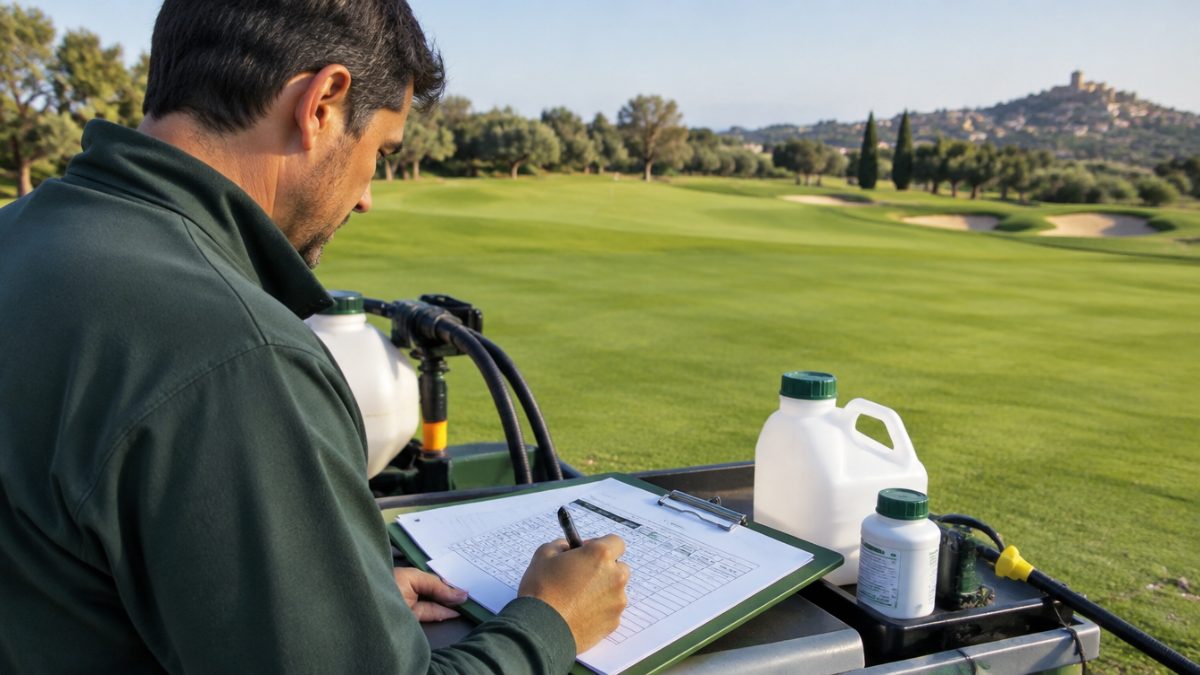
A plant growth regulator programme is only defensible in front of the green committee if it is documented. Record which zone was treated, when, in what weather conditions, who applied it, what equipment was used and what response was observed in the following days. Without that history, it is impossible to compare seasons or correct mistakes.
It also helps to define simple indicators to evaluate the result:
- Mowing hours per zone and week.
- Volume of clippings collected.
- Visual assessment of density and colour.
- Player feedback and perceived quality.
Combining records with field observation lets you refine year after year and decide whether to keep, expand or reduce the use of these tools.
Further reading: GCSAA. To learn more about turf management and best practices, you can consult the GCSAA resources.
Frequently asked questions
What exactly are plant growth regulators on a golf course?
They are products that change the turf's growth rate, above all the elongation of leaves and stems. Used well, they reduce clippings, help density and make the surface more consistent. Their use must always follow the label, current regulations and the advice of a licensed technician.
Can plant growth regulators be used on every type of turf?
Not indiscriminately. The response varies with the species, season, temperature, fertilisation and condition of the turf. Before adopting them, assess each zone, check the product label and ask a licensed adviser for guidance, especially on greens and on turf under stress.
How do I know if plant growth regulators are worth using?
By comparing data before and after: mowing hours, volume of clippings, surface quality and programme cost. If you record each application and the response observed over several weeks, you will have an objective basis to decide whether to keep them, adjust them or limit them to specific areas of the course.
Keep reading
- Mowing height by turf zone Mowing height: a complete guide by course zone
- Recording pesticide treatments Pesticide Application Records: 6 Key Data Points
- Turf fertilisation by season Turf Fertilisation: 6 Guidelines by Season