

Moving the hole every day seems a minor task, but green wear, playing difficulty and the course’s image all depend on it. Choosing pin positions well is a technical decision that combines agronomy, strategy and common sense, and it is best planned rather than improvised each morning.
In this article we review six criteria for rotating them in an orderly way: the area of the green, slope, drainage, difficulty, accumulated wear and team organisation. At the end you will see how to document hole changes so they do not depend on anyone’s memory.
Why It Pays to Plan Pin Positions
When the hole is always cut in the same spots, player traffic is concentrated in a few square metres. The soil compacts, the turf weakens and footprints appear that ruin the putt. An orderly rotation spreads that wear over the whole surface.
But there are more advantages. Good pin positions keep the strategic interest of the hole, avoid monotony and let you adjust difficulty to each day: a social round is not the same as a high-level tournament. And they take pressure off problem areas, giving them time to recover.
Criterion 1: Spread Wear Across the Whole Green
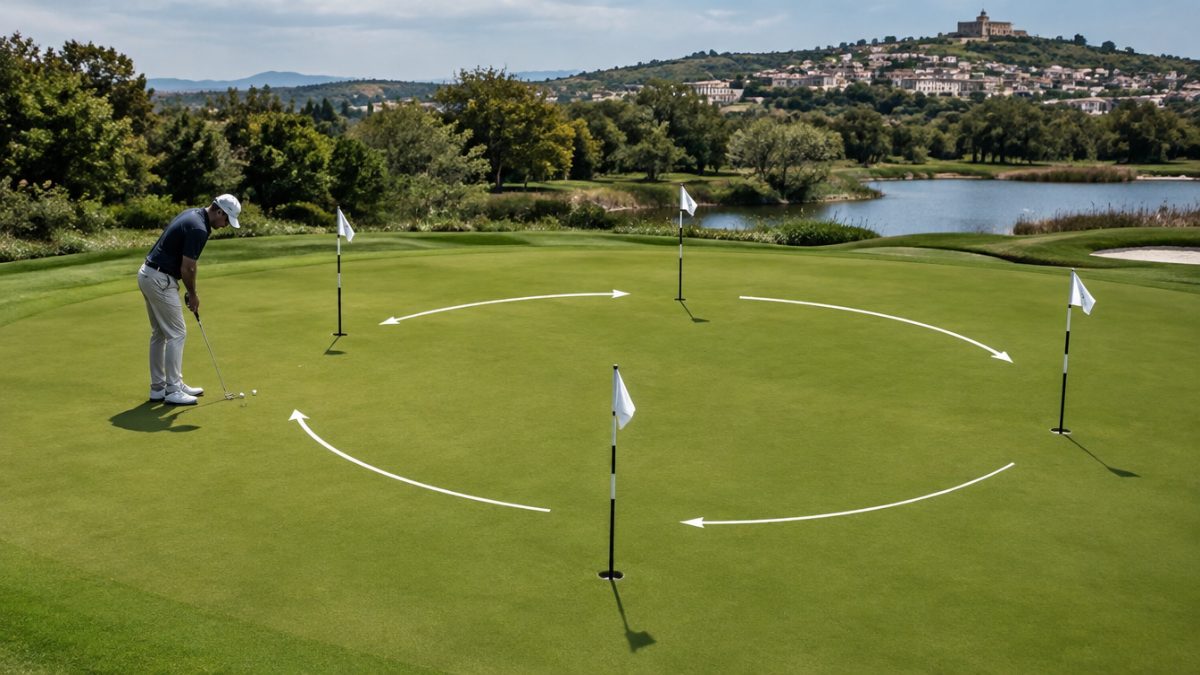
The basic rule is not to repeat the same spot too often. A simple way to organise this is to divide the green mentally into zones and work through them in turn.
- Define several positions per green, spread across front, centre, back and sides.
- Avoid placing the hole near the previous one two days in a row.
- Rest the highest-traffic spots for a few days.
- Rotate the cutting direction and the exact point within each zone.
With a written rotation scheme, any team member can follow it and results are more uniform over the season. A practical example: number the pin positions on each green from one to six and make the weekly scheme always move to a different zone, so that none is repeated before a full week has passed.
Criterion 2: Match Pin Positions to Slope and Speed
A pin position must be fairly playable. If the hole is placed near a steep slope, the putt can be unfair, especially on fast greens.
- Leave a sufficiently flat stretch around the hole, with few sharp slopes.
- Save the most demanding positions for days of lower green speed.
- Avoid placing the hole at the top of a slope when a very fast green is expected.
Knowing the slope map of each green well is key. With clear topography, pin positions can be classified as easy, medium and hard, and used according to the day’s event.
Criterion 3: Look After Drainage and Turf Condition
Not all areas of a green drain the same. Placing the hole at a spot that tends to waterlog after rain increases the risk of damage and deep marks. The same goes for areas weakened by shade, compaction or disease.
- Mark on a plan the points with poor drainage or fragile turf.
- Exclude those areas from the rotation after heavy rain.
- Use those days for positions in firmer, more resilient areas.
Choosing pin positions with this flexibility avoids injuring turf that is already struggling and lets problem areas recover through aeration or overseeding without extra pressure.

Criterion 4: Adapt Difficulty to the Type of Day
The same green can demand different things depending on who is playing. On a members’ day, it is best to prioritise accessible positions that favour a smooth pace of play. In a tournament, more demanding positions can be chosen, always within the fairness of the green.
A balanced distribution of pin positions across the holes helps the whole course stay coherent: not all flags should be near the edges nor all in the centre. A reasonable mix of front, middle and back positions makes the course varied without being excessively hard. It also helps if the committee and the greenkeeper review the pin position rotation together before each event, so that expectations on one side and real possibilities on the other match.
Criterion 5: Coordinate the Change with Other Tasks
Changing holes is part of the opening routine, along with mowing, rolling and irrigation. If it is not coordinated, it can hinder the team’s work or leave positions unprepared at tee-off time.
- Plan the change before the first tee times.
- Assign one person to cut the hole and place the flag.
- Check the quality of the cut: clean edges, correct depth and the plug well placed.
- Avoid changing the hole late in the day on delicate surfaces.
When pin positions are fixed in advance, the rest of the tasks are organised with less improvisation.
Criterion 6: Record the Pin Positions Each Day
The last criterion is the one most often neglected: noting what was done. Without a record, rotation depends on what each operator remembers, and it is easy to repeat positions without realising.
- Note each day the chosen spot on every green, using a simple diagram.
- Keep the history to review wear and detect overloaded areas.
- Communicate the rotation policy and criteria to management.
With a simple history you can defend your decisions, prepare a weekly rotation and adjust the scheme as each green evolves. Rotation stops being a habit and becomes a planning tool.
Further reading: R&A. The R&A publishes guidance on course set-up and pin positions in competition.
Frequently asked questions
How often should pin positions be changed?
The usual practice is to change the hole daily, or every few days on courses with less play, following a predefined rotation scheme. The exact frequency depends on the volume of play and the condition of the green. What matters is not repeating the same spot too often and resting the areas with the most wear.
How many pin positions should be defined per green?
There is no required number, but with a few well-distributed positions it is hard to fall into repetition. Ideally you have a sufficient range to cover front, middle, back and side areas, and classify them by difficulty. That way you can adapt the choice to the type of day and the condition of the turf.
Who should decide the pin positions in a tournament?
Normally it is coordinated between the competitions committee and the person in charge of maintenance. The greenkeeper contributes knowledge of slopes, drainage and turf condition; the committee defines the desired level of difficulty. Agreeing it in advance and in writing avoids misunderstandings and ensures positions are fair and workable.
Keep reading
- The greenkeeper's daily planning Daily greenkeeper planning: 6 effective steps
- Stimpmeter: measuring green speed Stimpmeter: 5 Steps to Measure Green Speed
- How to organise the greenkeeping team Greenkeeping team: 6 key roles and responsibilities