
Every course has “its way of doing things”, but in too many cases that way lives only in the head of the veteran who has been on the crew for twenty years. Documenting golf course work procedures is not bureaucracy: it is the cheapest way to achieve consistent results, train new starters quickly and reduce errors in delicate tasks.
Here are six protocols worth writing first, with a simple structure you can copy and adapt to your course. You will see what each should include, who should review them and how to stop them ending up forgotten in a drawer.
Protocol for mowing greens and precision areas
This is the procedure where the difference between operators shows most. It should cover mowing height, direction of passes, turning pattern, the pre-use machine check and what to do if there is excess moisture or dew when you have to start.
- Check of blades, settings and fuel level before heading out.
- Alternating patterns so as not to mark the green.
- Turning area off the green and collection of clippings.
- Immediate notice to the supervisor of any surface anomaly.
A good mowing protocol fits on one sheet and can be understood in five minutes. If it takes three pages, it probably mixes instructions with explanations that belong in training.
A good practice is to accompany this and the other golf course work procedures with photographs of the expected result: a freshly mowed green, a correct pass pattern, a clean edge. An image prevents more misunderstandings than a whole paragraph.
Protocol for changing holes and maintaining flags
Changing the hole looks simple, but it is one of those tasks where haste leaves its mark: badly made cuts, protruding plugs, trampled edges. Document the order of operations, the tool, how to restore the cup surround and the criteria for spreading hole locations around the green over the week.
- Choose the new location according to the weekly plan.
- Extract the plug and fill the old one with sod or sand as appropriate.
- Check the level and depth of the new hole.
- Check the flag, pole and hole before leaving the green.
Golf course work procedures for irrigation and sprinkler checks
Irrigation is the task with the most consequences if done without judgement. A good procedure describes who programmes, who checks in the field and how incidents are reported. It also defines what to do when an area is short of water or when a breakdown forces night irrigation to be suspended.
Always include a minimum check-round protocol: checking sprinkler rotation, visible pressure, clogged heads and puddles. And set how each finding is recorded, because a fault that is seen but not recorded will be repeated.
This is one of the golf course work procedures that pays for itself fastest: a clogged head detected in time saves water, avoids a dry area and also saves an argument with the player who finds the green with patches.
- Person responsible for programming and for supervision.
- Check round with a checklist.
- A single channel for reporting breakdowns.
Protocol for pesticide and fertiliser applications
Here golf course work procedures become especially critical, for safety, the environment and regulations. Without going into rates or products, which depend on the label, current regulations and the advice of a licensed technician, the protocol must set the preparation sequence, the protective equipment, machine calibration and the subsequent record.
- Prior check of weather conditions and the area to be treated.
- Mandatory use of personal protective equipment.
- Calibration and cleaning of the sprayer after each use.
- Recording of date, area, product, applicator and observations.
This last point is the most overlooked. A treatment without a record is a treatment that cannot be defended at an inspection or evaluated against a result.

Golf course work procedures for cleaning, greasing and storing machinery
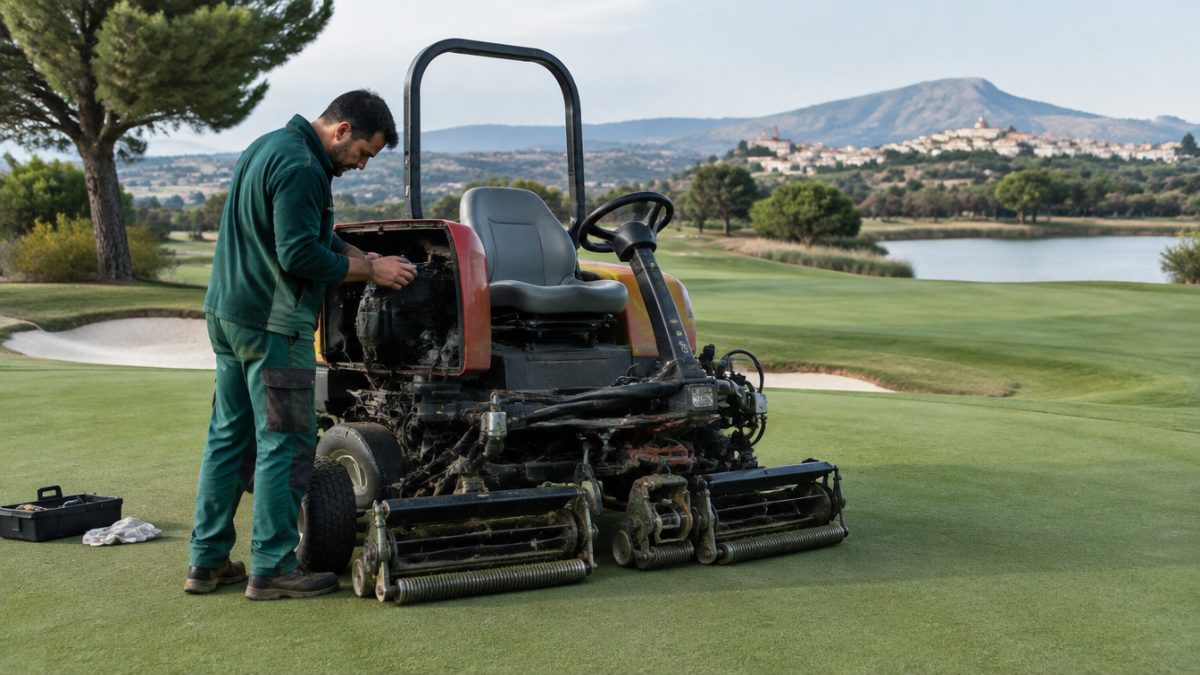
The end of the working day is where machine life is won or lost. Document how each machine is cleaned, which points are greased, where it is stored and how a breakdown noticed during work is reported. It seems basic, but it makes the difference between an orderly workshop and one firefighting.
- Washing in the designated area and collection of waste.
- Visual check for leaks, blades and tyres.
- Incident report signed by the operator.
When golf course work procedures include this daily close-down, preventive maintenance stops being a separate project and becomes part of the whole crew’s habit.
Protocol for safety, incidents and daily communication
The sixth protocol is not about turf but about people. It defines how work is allocated in the morning, who talks to the office, how players are warned when machinery is working and what to do in the event of an accident or a risk situation. Having this in writing avoids improvised decisions at the worst moments.
Here golf course work procedures must also take account of newcomers: seasonal staff, interns or extra staff for a tournament. A welcome page with the basic rules, contact numbers and restricted areas lets them be useful from day one without constantly interrupting the supervisor.
- A short meeting at the start of the day with the day’s tasks.
- Rules for vehicle movement and for crossing playing areas.
- Procedure for an accident, spill or incident involving players.
Finally, schedule an annual review of all the protocols. Golf course work procedures are not a static document: they change with the machinery, the staff and the demands of the course, and they only work if the crew recognises them as their own.
Further reading: Ministerio para la Transición Ecológica (Spain's Ministry for the Ecological Transition). For product applications and waste management, consult the official information from Spain's Ministry for the Ecological Transition (MITECO) and the requirements that apply in your region.
Frequently asked questions
What are golf course work procedures?
They are written, clear and brief instructions describing how each course maintenance task is carried out: who does it, with what resources, in what order and how it is recorded. Their aim is for the result to be the same regardless of who works that day, and to make crew training easier.
Who should write the course protocols?
Ideally the head greenkeeper writes them together with the operators who do the task, because they know the real details. They should then be reviewed with management on safety and regulatory aspects. A procedure imposed without consulting the crew usually stays on paper.
How often should golf course work procedures be reviewed?
Golf course work procedures should be reviewed at least once a year, and whenever the machinery, staff or the way a task is carried out changes. It is also worth reviewing a protocol after any incident. An outdated document is worse than none, because it conveys instructions the crew no longer follows.
Keep reading
- How to plan the greenkeeper's day Daily greenkeeper planning: 6 effective steps
- Organising the greenkeeping team Greenkeeping team: 6 key roles and responsibilities
- Occupational risk prevention in greenkeeping Risk Prevention in Greenkeeping: 7 Practical Measures