
Drought on golf courses is no longer an exceptional episode across much of Spain: it is a scenario you need to have prepared for. When restrictions arrive, the clubs that planned ahead keep playing quality where it matters most; those that did not improvise, lose turf and argue with their members.
These are seven contingency measures for a course maintenance team: from setting priorities by zone to improving irrigation efficiency, adapting turf management and explaining decisions to management and players. All of them can be started before drought on golf courses turns into an emergency.
Measure 1: Define priorities by surface
If there is not enough water for everything, you have to decide in advance what gets protected first. A reasonable order, which each club must adapt to its own reality, usually puts greens and tee boxes at the top, followed by fairways and, last of all, rough and ornamental areas.
Document that hierarchy and agree it with management and the greens committee before summer. When the restriction arrives, nobody will have to debate under pressure, and the team can apply the plan immediately. Also define which areas can be left unirrigated or on minimal survival irrigation without compromising the structure of the course.
A drought plan for golf courses must also cover events and tournaments: what happens if they coincide with a restriction, which commitments can be renegotiated and what level of presentation is reasonable to expect from the course in those weeks. Talking it through early with the sports director avoids last-minute tension.
Measure 2: Know your water numbers before drought hits
Without data, drought on golf courses is managed blind. Calculate how much water each zone uses, which sources it comes from and how much reserve is available in reservoirs or tanks. Compare the irrigation applied with the evapotranspiration of the period to see whether you are over-watering.
- Consumption per hectare and per type of surface.
- Days of reserve autonomy at normal and reduced rates.
- Quality of the water available, including salinity if sources are mixed.
It pays to update these figures every week for as long as the drought lasts. These numbers turn decisions into calculations and let you negotiate with the authorities or the irrigation community with firm arguments.
Measure 3: Improve irrigation efficiency
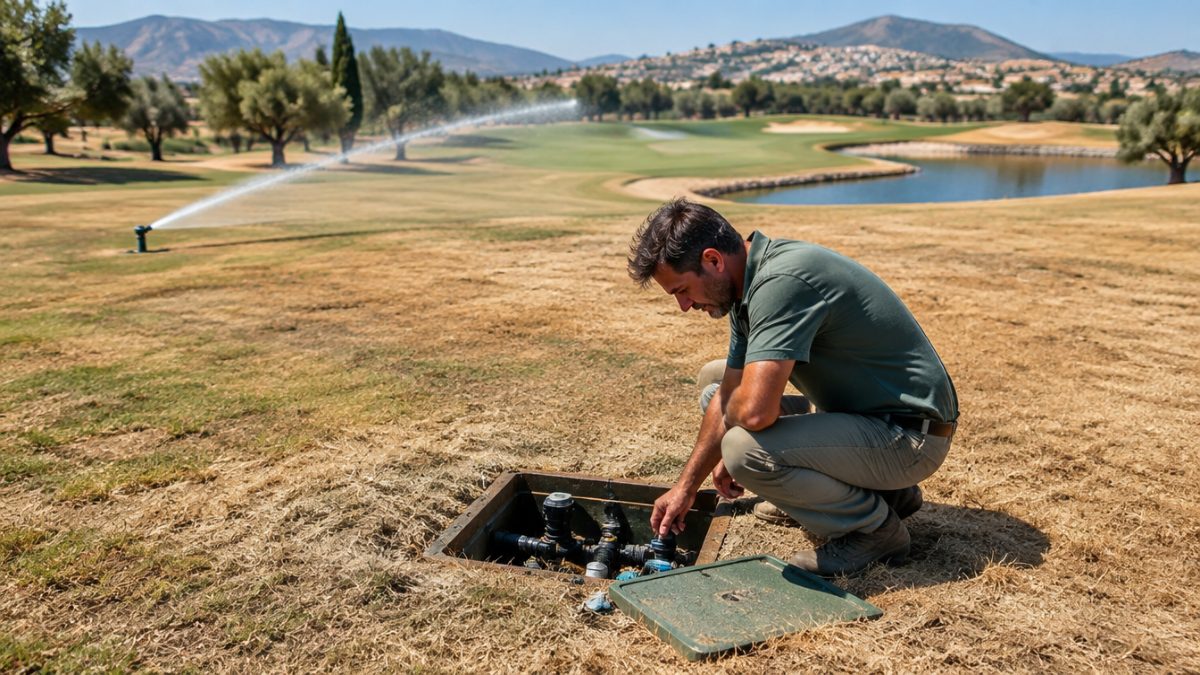
Before cutting volume, make sure no water is being lost. Check for leaks, misaligned sprinklers, worn nozzles, out-of-range pressures and badly calculated overlaps. An irrigation audit often uncovers significant losses without sacrificing playing quality.
Adjust schedules to deep, spaced-out irrigation, at night or pre-dawn, to reduce evaporation and wind drift. In zones with different exposure, programme independent sectors; uniform irrigation across the whole course wastes resources. When drought on golf courses bites, every point of efficiency is worth days of reserve.
Measure 4: Adapt turf management to water stress
Well-rooted turf withstands more. Raise the mowing height slightly where play allows, reduce mowing frequency, moderate nitrogen and avoid aggressive operations such as heavy scarifying in the middle of stress. Aeration helps water infiltrate and deepens rooting.
Watch for hydrophobic areas, where water does not penetrate and is lost as runoff, and use supporting treatments only under technical guidance, following the label and current regulations. With controlled deficit irrigation, some species such as bermudagrass or paspalum tolerate dry spells better than cool-season grasses, something to bear in mind in future renovations.
Measure 5: Diversify your water sources
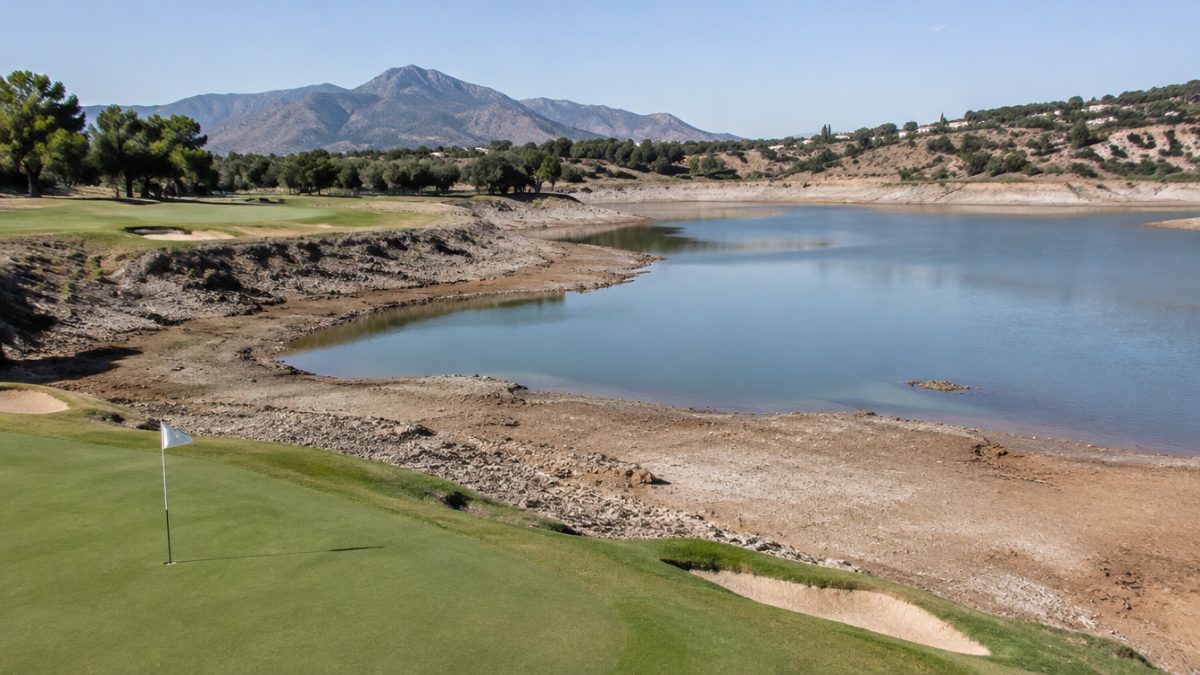
Depending on a single source is a risk. Study, with the advice and authorisations that apply, the use of reclaimed water, rainwater harvesting, reuse of runoff water or expanding storage.
No single solution solves a prolonged drought on golf courses, but combining several gives you room to manoeuvre. Each alternative requires analysing quality, salinity and the possible effects on soil and turf. Reclaimed water, for example, needs specific management of salts and nutrients. Do not forget either that the best source is the water you do not lose: well-lined reservoirs, covered where feasible and with evaporation control, add autonomy without touching the system.
Measure 6: Reduce irrigated area and move to extensive management
The most structural measure against drought on golf courses is to reduce the area that needs intensive irrigation. Converting roughs of low playing value into extensively managed zones with adapted vegetation cuts consumption and maintenance costs, as well as adding biodiversity.
Plan it with the game in mind: it should not hurt pace of play or increase lost balls. And do it in phases, with pilot zones that let you check the result and gather players’ opinions. A well-explained transition is accepted far better than a change imposed all at once.
Calculate the expected saving for each candidate zone, including water, mowing hours, fuel and fertilizer. That comparison shows which hectares give the most back for every litre not applied and helps decide the order of action. In the medium term, a course with less intensively irrigated area copes better with any future drought on golf courses.
Measure 7: Communicate transparently and record everything
Members tolerate a drier course better if they understand why. Explain the situation with data: reserves, restrictions, priorities and the club’s efforts. A short notice, with photographs and a timeline, prevents rumours and strengthens trust in the team.
Record every decision during the shortage: volumes applied, zones on reduced irrigation, incidents, turf condition and measures taken. That history is the best basis for learning, for justifying decisions to the authorities and for improving next year’s plan. At the end of each episode, review what worked and update the protocol: drought on golf courses will come back, and you will be better prepared.
Further reading: AEMET. To follow rainfall trends and water shortage episodes, it is worth consulting the official information of AEMET, Spain's State Meteorological Agency.
Frequently asked questions
What gets priority during a drought on golf courses?
Normally greens and tee boxes, because of their role in play and their sensitivity, followed by fairways and finally rough. Each club must define and approve its own order in advance, taking into account species, soil profile, type of members and official restrictions.
How much can irrigation be reduced without damaging the turf?
There is no universal figure. It depends on the species, the soil, the climate and the condition of the system. The safe strategy is to reduce progressively, measure moisture and turf response, and prioritise deep, spaced-out irrigation with strong rooting.
How do you keep members informed during a drought?
With short, regular notices that explain the situation, the measures taken and the results, backed by data and photographs. Speaking clearly about priorities and limitations avoids misunderstandings and usually builds support, even when the look of the course changes for a few weeks.
Keep reading
- Deficit irrigation: how to apply it without losing quality Deficit Irrigation in Golf: 5 Rules for Applying It
- Reclaimed water for irrigation on golf courses Reclaimed Water for Irrigation: 6 Keys for Your Course
- Evapotranspiration: the basis for irrigation scheduling Evapotranspiration in golf: 5 keys to watering just right