
A sprinkler part is missing on a Friday afternoon, or twenty expired bags of fertiliser turn up at the back of the store. They are two sides of the same problem: a course materials inventory that nobody really controls. The result is emergency purchases, money sitting on shelves and jobs that get delayed. Keeping a good course materials inventory is not bureaucracy: it is the basis for planning ahead.
Let us go through six practical rules for organising inventory on a golf course, with criteria that work equally well for a nine-hole course or a resort. You will see what to count, how to do it, how often and how to get the team to keep it alive.
Define what goes into the course materials inventory
The first common mistake is trying to control everything or controlling nothing. You need to decide which categories deserve tracking and which do not justify the effort. A loose screw does not need a record card; a bag of seed or a critical spare part does.
- Agronomic consumables: seed, fertilisers, top-dressing sand, amendments and plant protection products.
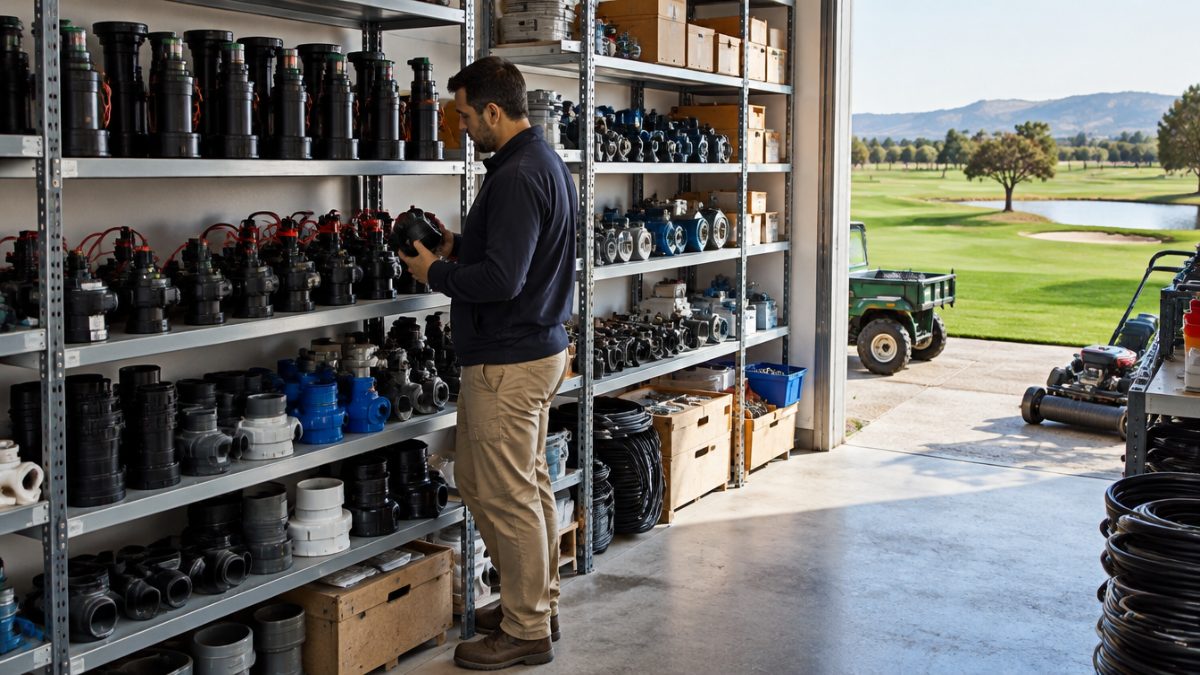
- Irrigation: sprinklers, nozzles, pipes, fittings and common repair parts.
- Machinery: filters, blades, oils, belts and wear parts.
- Course equipment: flags, cups, markers, stakes, ropes and signage.
- Staff protection: gloves, goggles, footwear and work clothing.
A good starting point is to list everything bought in the last year and keep what is used regularly or whose failure stops a job. That way, the course materials inventory starts small, useful and easy to maintain, and only grows once the team handles it comfortably.
Set the stage: the course materials inventory starts in the store
Before moving on to physical organisation, you should settle who is in charge of each area of the store and how keys and access are handed out. Without that clear responsibility, any control system fades away within weeks.
Tidy the store before you count
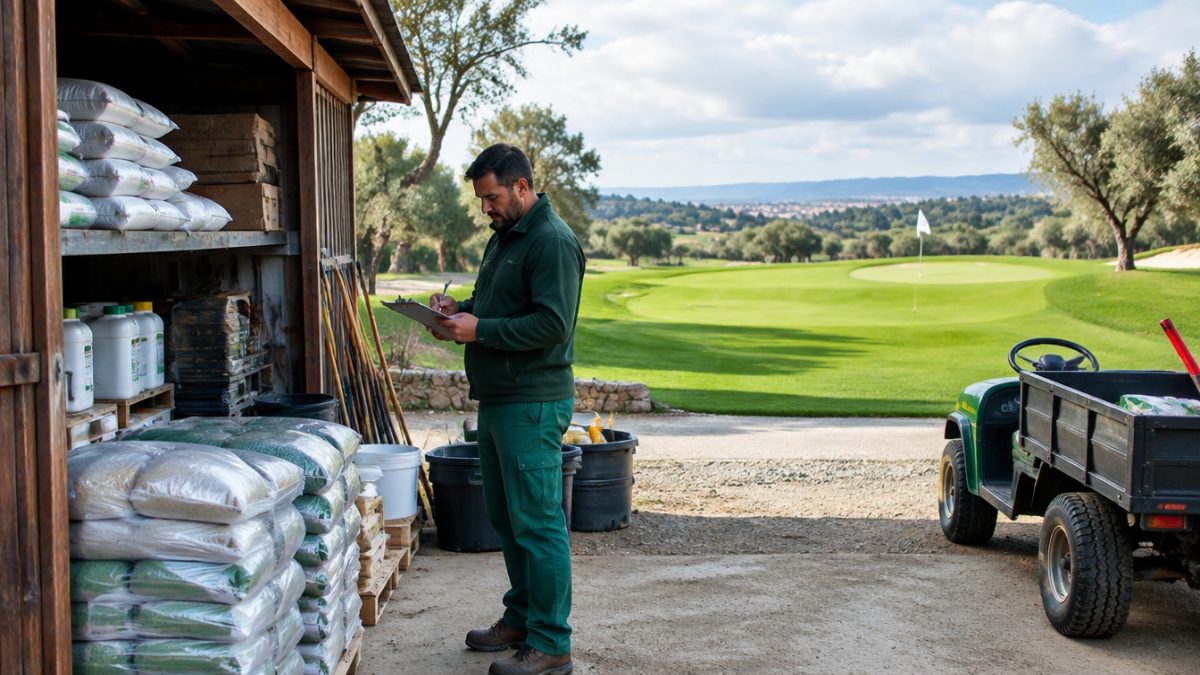
No course materials inventory works in a chaotic store. If everything has its place, counting takes minutes; if not, it takes hours and is done badly. Before you start, set aside a day to clean, clear out the obsolete and label the shelves.
- Assign fixed locations and label them with clear names the whole team understands.
- Separate by type: chemicals, flammables and moisture-sensitive items need their own conditions.
- Apply the first-in, first-out principle, especially for products with an expiry date.
- Keep plant protection products in a suitable space and in line with current regulations, with advice from an authorised technician.
Set sensible minimums and reorder points
A course materials inventory is of little use if it does not answer one question: when do we need to buy? For each relevant item, define a minimum quantity below which an order is triggered. That minimum depends on normal usage and the supplier’s lead time.
A course example: top-dressing sand is used heavily in spring and autumn but hardly at all in summer; the August minimum is not the April one. Irrigation spares, on the other hand, are needed exactly when the system fails, so it pays to keep a small buffer of the most critical ones.
- Review minimums when the season or work programme changes.
- Prioritise items whose absence stops a task or puts the turf at risk.
- Ask the supplier for real lead times, not just the promised ones.
Record receipts and issues as they happen
The rule that fails most often in practice is writing down every movement when it happens. If it is left until the end of the week, nobody remembers what was taken or why. A simple, always-available method is enough, whether a sheet in the store or a digital tool.
- Each issue should state the quantity, who is taking it and for which task or area.
- Each receipt should be checked against the delivery note, noting the date and supplier.
- Returns and leftovers are also recorded, so stock is neither inflated nor thrown off.
When an issue is tied to a specific task, the course materials inventory stops being a simple count and becomes cost information by area or by task.
Count regularly and reconcile differences
Even if everything is recorded, discrepancies always appear: a torn bag, a wrongly noted measure, an unrecorded loan. That is why you should cross-check against a physical count at regular intervals. The most valuable or most critical items deserve more frequent counts than those rarely used, and the course materials inventory should always reflect the result of the latest count.
- Choose a frequency for each category, for example monthly for critical items and every six months for secondary ones.
- Always have someone other than the person who manages receipts do the counting.
- Note the differences and find out the cause before adjusting stock.
- Fix the procedure if the same discrepancy keeps recurring.
The aim is not to find culprits, but to detect whether the method, the training or the location of the material is failing.
Use inventory data to decide and communicate
A well-kept course materials inventory provides valuable information for the budget and for the green committee. It lets you see which materials consume the most resources, which purchases are repeated for lack of planning and which products have been sitting idle for months.
- Review items with no movement and consider whether they can be returned, used or disposed of.
- Compare consumption between seasons to fine-tune annual purchases.
- Group orders to negotiate better with suppliers and cut delivery costs.
- Present management with a simple summary of stock, consumption and needs.
- Close each season with a final review of the course materials inventory and of the purchases that would be worth bringing forward.
With this information, budget conversations stop relying on impressions and start resting on verifiable facts.
Further reading: GCSAA. The GCSAA, the golf course superintendents association, publishes general guides to good maintenance management practices.
Frequently asked questions
How often should the course materials inventory be reviewed?
It depends on the type of item. Critical or higher-value materials, such as irrigation spares or agronomic consumables, can be cross-checked with a physical count every month. Rarely used items can be reviewed every six months. What matters is to set a calendar, stick to it and record the differences so you can correct the method when they repeat.
Who should be responsible for the inventory?
It is best to appoint one person responsible for the store, usually a mechanic or an assistant to the head greenkeeper, and have someone else carry out the cross-check counts. This spreads the control, avoids undetected errors and lets the head greenkeeper keep the overall view without having to count everything personally.
What do I do with expired or unused products?
They are separated, recorded and managed according to their nature and current regulations. For plant protection products, you must follow the label and rely on the advice of an authorised technician for their disposal. An up-to-date course materials inventory lets you spot them sooner and avoid duplicate purchases.
Keep reading
- How to organise a plant protection product store Pesticide Storage: 7 Safety Rules
- Cost control per task in maintenance Task Cost Control: 5 Steps on the Golf Course
- Work procedures on golf courses Golf Course Work Procedures: 6 Key Protocols