
No greenkeeper needs a scientific report to notice that something has changed: heat waves that last longer, rain that falls all at once, milder winters that favour pests and diseases outside their usual season. Climate change in golf is not an abstract debate, but a factor that shapes irrigation, species choice and the budget.
This article proposes six realistic adaptation measures, designed for Mediterranean-climate courses, which you can start applying gradually. You will see how to analyse your risk, what to change first and how to measure whether climate change in golf is affecting you more or less than last year.
Diagnose how climate change in golf affects your specific course
Not every course suffers the same. A coastal layout with brackish water, an inland one with cold winters and a hillside one with thin soils have different vulnerabilities. The first step is to recognise yours with your own data, not with impressions.
Review over several seasons:
- Extreme heat episodes and their effect on greens and tee boxes.
- Heavy rain: where it ponds, where it erodes, which drains collapse.
- Changes in the appearance of diseases, insects and weeds.
- Availability and quality of irrigation water throughout the year.
If the team notes these episodes each time they occur, within a few years you will have a useful history to decide investments and to explain to management why climate change in golf requires adjusting the maintenance plan.
Irrigate with more precision and less volume
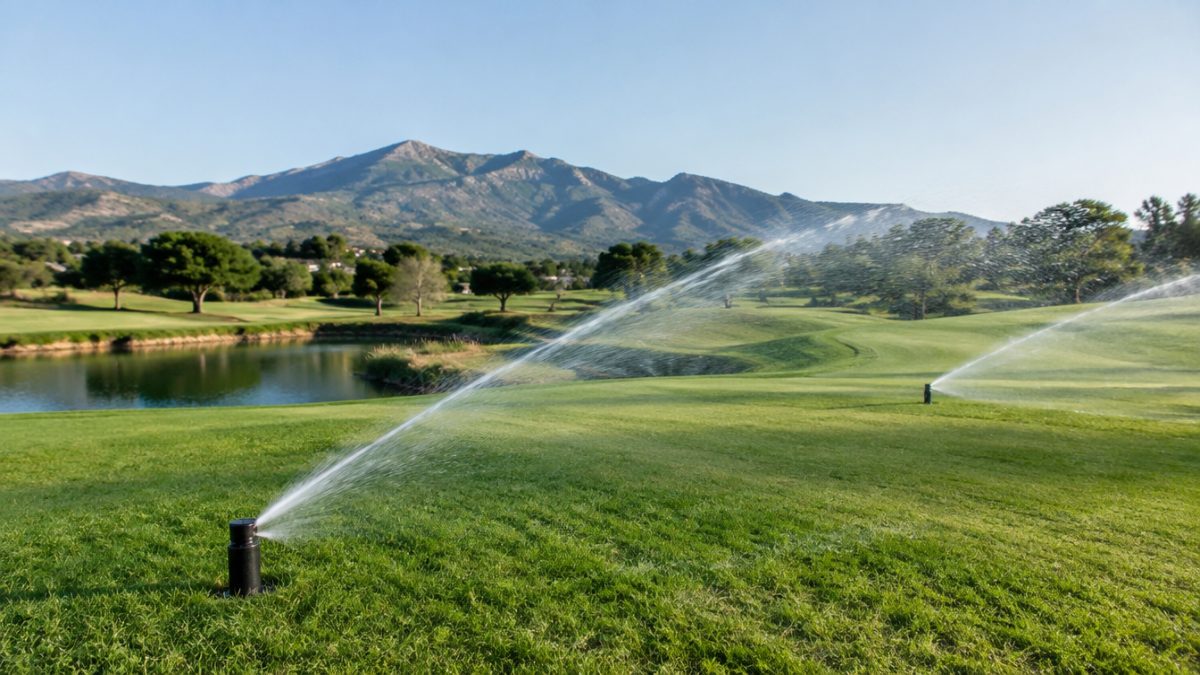
Water is where climate change in golf is felt most, and also where there is most room to improve. A well-maintained system and irrigation guided by the turf’s real demand let you cut consumption without sacrificing quality.
Common measures:
- Check the uniformity of the system and repair leaks and faulty sprinklers.
- Schedule by evapotranspiration, not by habit.
- Irrigate critical zones in a targeted way and reduce on the least demanding ones.
- Consider reclaimed water or other alternative sources, knowing their quality.
The idea is not to irrigate less blindly, but to irrigate just right. A course that knows the real moisture of its soil, applies deeper, more spaced-out irrigation and avoids excess during the hours of peak evaporation withstands heat waves better.
Choose more tolerant species and cultivars
When a surface suffers year after year, perhaps the problem is not management but the species. Warm-season grasses such as bermudagrass, paspalum or kikuyu tolerate heat and salinity better than cool-season ones, although the latter give winter colour. Each option has advantages and costs.
When considering changes, think it through calmly:
- Do not replace everything at once: start with pilot zones such as tee boxes or fairways.
- Assess tolerance to drought, salt and local diseases.
- Ask suppliers and nurseries about the real performance of each cultivar in similar climates.
- Consider how it will affect the presentation of the course in each season.
The answer is rarely universal. A good decision draws on the experience of neighbouring courses and on controlled trials on your own.
Prepare soil and drainage for extreme rainfall
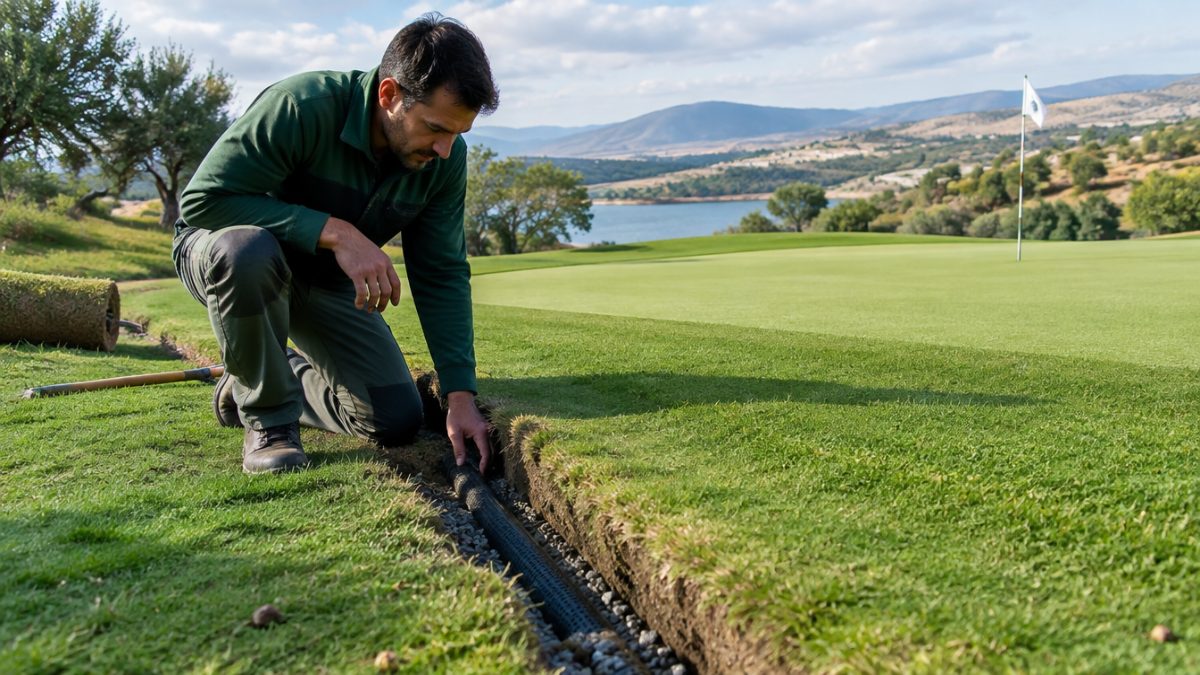
Climate change in golf does not only bring drought: it also brings downpours that concentrate in hours what used to fall over weeks. Compacted soil or drainage with clogged pipes turns a storm into weeks of closed fairways.
It pays to work on prevention:
- Keep sumps, ditches and drain outlets clean before the rainy seasons.
- Aerate regularly to preserve porosity and infiltration.
- Check slopes and lake edges prone to erosion.
- Identify the low areas where water collects and plan grade improvements or supplementary drainage.
When a heavy storm arrives, a prior plan of which areas close, who checks what and how washed-in debris is cleaned up reduces the damage and shortens recovery.
Anticipate pests and diseases with integrated management
Mild winters and hot, humid summers change the calendars of pathogens and insects. What used to appear in a specific week may come earlier, later or repeat. In the face of climate change in golf, the most sensible response is not to treat more, but to observe better.
Opt for an integrated approach: regular monitoring, improving growing conditions (aeration, balanced fertilization, control of leaf wetness) and using treatments only when justified, always following the label, current regulations and the advice of an authorised technician or adviser.
A reliable history of what was detected, when and under which weather conditions helps you see patterns and act before the problem is visible to the player.
Reduce emissions and make use of the course's own resources
Adapting is necessary, but helping to slow the problem also counts. There are reasonable mitigation measures that also tend to cut operating costs:
- Optimise machinery routes and schedules to avoid duplicated work.
- Consider electric or lower-consumption equipment when it is time to renew.
- Make use of clippings and pruning waste through composting.
- Maintain and expand trees and naturalised areas, which provide shade, biodiversity and carbon capture.
- Measure the energy consumption of pumping stations and buildings.
A club that shows it manages climate change in golf responsibly improves its image with members, authorities and sponsors, and is better positioned if environmental indicators are ever required.
Measure, report and review the plan every season
No adaptation works if it is not measured. Set a few simple indicators and review them every season: water consumption per hectare, labour hours per zone, incidents due to rain or heat, days of closed course, area of turf renovated.
Presenting them to the greens committee at a fixed interval, with clear charts, makes it easier to justify investment items and prioritise actions. It also lets you learn: if a measure does not improve results, you correct it.
Treat the plan as a living document. Climate change in golf advances unevenly, and what is a sound decision today may fall short in a few years. Reviewing it regularly avoids surprises and keeps the team aligned.
Further reading: IPCC. To understand the general scientific framework of climate scenarios, you can consult the information from the IPCC
Frequently asked questions
How does climate change in golf affect turf maintenance?
It alters the calendar of diseases and pests, increases heat and water stress and brings intense rain that damages drains and slopes. The practical effect is more demanding irrigation, more pest and disease scouting and a greater need to plan with the course's own data.
What is the first thing a course should do about climate change in golf?
Recognise its own vulnerability: available water, condition of drainage, species and the extreme episodes already experienced. With that diagnosis, measures are prioritised, normally starting by improving irrigation efficiency and systematically recording the incidents of each season.
Do you have to change turf species because of climate change in golf?
Not always. First it is worth improving irrigation, aeration and fertilization. If a surface still suffers every summer, you can trial species more tolerant of heat or salt in pilot zones, weighing their winter appearance and the performance observed on courses with a similar climate.
Keep reading
- Carbon footprint in golf: how to measure it Carbon Footprint in Golf: 6 Steps to Measure It
- Contingency measures for drought Drought on Golf Courses: 7 Contingency Measures
- Reclaimed water for irrigation Reclaimed Water for Irrigation: 6 Keys for Your Course