

Bunker sand is one of those decisions made once and paid for over many years. A good choice gives a consistent bunker that is easy to rake with little erosion; a wrong one produces plugged balls, crusting after rain, player complaints and many hours of repair.
Here are five criteria for choosing the right bunker sand for your course. There is no perfect sand for everyone, but there is a simple method for comparing samples, asking the supplier the right questions and making a decision that stands the test of time.
Criterion 1: The particle shape of the bunker sand
The shape of the particles in bunker sand determines stability and ball behaviour, and it is the first filter to apply to any sample. Angular-grained sands tend to lock together, form a more stable surface and reduce the risk of plugged balls on steep faces. Rounded-grain sands flow more easily, are looser and can leave balls sitting deeper in the bunker floor.
A good practice is to test a sample on the course itself, on the real slope of a face, and observe:
- Whether the sand slides off or holds on the incline.
- How the ball behaves when it lands from a typical shot height.
- What the footprint looks like after being stepped on or raked.
Criterion 2: Particle size distribution and fines content
The distribution of particle sizes is decisive. A sand that is too fine compacts, crusts with rain and retains water; one that is too coarse plays hard and can be uncomfortable. Fines, silts and clays, are the enemy: they hinder drainage and encourage the formation of hard layers.
Always ask the supplier for a particle size analysis and compare it between batches. The ideal is a balanced distribution with a very low fines content. When you change supplier or quarry, check that the new delivery is consistent with the previous one, because batch-to-batch variation produces different bunkers on the same course.
A common example: a club buys a new batch of slightly finer bunker sand to save money and, by the first winter, finds crusting on the floors and plugged balls on the faces. The initial saving disappears in repair hours and in player annoyance. That is why laboratory analysis always pays off, and it is worth repeating each time a large delivery arrives.

Criterion 3: Compaction and surface firmness
The firmness of bunker sand determines how far the ball sinks and what kind of shot results. A surface that is too soft encourages plugged balls; one that is too hard resembles a path and unsettles the player.
This characteristic depends on the sand, but also on the thickness of the layer, the substrate it sits on and the moisture. As a guide, very deep layers increase cost, runoff erosion in low areas and maintenance effort; layers that are too thin expose the floor and give an inconsistent experience. It is best decided with the architect or the course manager.
The way you rake also matters. Very deep, frequent raking loosens the bunker sand too much and makes it easier for the ball to plug; shallow raking, matched to actual use, maintains firmness and reduces wear on the faces. Defining a common raking standard for the whole team avoids uneven bunkers on the same course.
Criterion 4: Drainage and behaviour in the rain
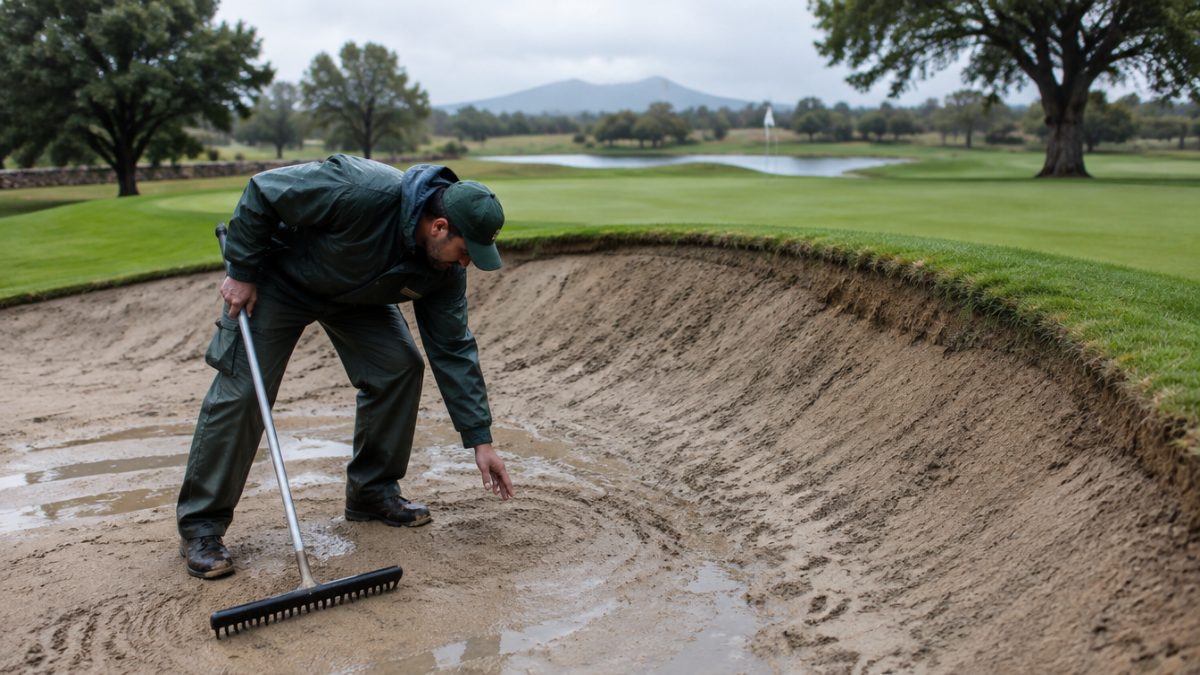
A bunker that floods loses sand, produces mud and forces the area to close. The permeability of the sand and the drainage of the base work together: a good sand on a base that does not shed water is no use, and neither is a good drainage system with sand that seals.
- Check that the bunker sand keeps its infiltration after several cycles of rain and drying.
- Inspect the condition of the pipes and outlets each season.
- Prevent sediment arriving by runoff from turf areas or paths.
If the course gets intense, concentrated rainfall, as is usual in a Mediterranean climate, this point weighs especially heavily.
Criterion 5: Colour, aesthetics and total cost of upkeep
Colour matters, and not only for looks. A very white sand offers visual contrast and a premium appearance, but it can produce annoying glare in the sun. A darker or warmer tone blends better into the landscape and hides dirt. What matters is that the colour stays stable over time and does not fade as fines contaminate it.
When evaluating bunker sand, do not look only at the price per tonne. Also consider:
- The cost of transport and the logistics of replenishment.
- Durability: how long it keeps its properties.
- Maintenance effort: raking, top-ups and erosion repairs.
- Future availability of the same material.
How to test and decide before buying
Before renewing all the bunkers, run a trial in one or two. Choose representative bunkers, install the sand, let it work for several months with real play and record its behaviour after rain, irrigation and raking. Ask for opinions from the maintenance team, regular players and the club’s professionals.
Always keep reference samples from each batch of bunker sand you buy, together with the delivery note and the analysis. If the behaviour changes in a few years, that sample will let you tell whether the sand has varied or the management has. Finally, record top-ups and repairs to calculate the real cost per bunker and per season.
Further reading: R&A. The R&A publishes rules and guidance that help explain how a bunker shot is played and what is expected of the bunker's condition.
Frequently asked questions
Which bunker sand is best for a course with heavy rainfall?
A sand with low fines content, good permeability and preferably angular grains usually performs better in heavy rain, provided the base drainage works. Test a sample over several weeks of rain and check that it does not crust, does not erode and soon recovers its playing condition.
How often should bunker sand be topped up?
It depends on erosion, play and fines contamination. Instead of setting a single calendar, it is better to check the depth and quality of each bunker regularly and top up when exposed floors or hardening are detected. Recording top-ups helps anticipate costs and plan purchases.
Can sands from different sources be mixed on the same course?
It is possible, but it produces bunkers with different behaviour and complicates maintenance. If unavoidable, keep each type of bunker sand within separate zones and note clearly where each one is. The ideal is to unify criteria when the course is renovated, for consistency of play.
Keep reading
- Bunker maintenance: tasks for better play Bunker Maintenance: 7 Tasks for Better Play
- USGA greens: keys to layered construction USGA Green Construction: 6 Keys to the Layered Profile
- Complete guide to turf maintenance on golf courses Complete guide to turf maintenance on golf courses