

Many golf courses learn the trade the way it has always been done: by watching the veteran colleague at work. It works until that colleague retires, moves to another club or falls ill. Greenkeeping staff training turns that scattered know-how into capabilities shared by the whole team, and it is one of the investments with the best ratio of effort to result.
In the lines that follow you will find six key skills, from workplace safety to reading the turf, and a practical formula for organising training during the season. A large budget is not needed: what is needed is consistency, judgement and a plan.
Skill 1: safety and prevention as the foundation of training
Any greenkeeping staff training plan should start with safety. Working with heavy machinery, slopes, chemical products and extreme heat involves real risks, and most accidents are avoided with simple, well-learned habits.
The basic content usually includes:
- Correct use of personal protective equipment.
- Starting, stopping and safe operation of each machine.
- Working on banks and near water.
- How to act in case of heatstroke, cuts and emergencies.
Greenkeeping staff training that starts here also conveys a clear message: nobody sacrifices their safety to finish a task sooner. This training has legal occupational risk prevention requirements that the club must meet, so it is advisable to rely on the prevention service and current regulations. Repeating it at the start of every season also stops routine from making people forget the essentials.
Skill 2: machinery operation and first-level maintenance
A poorly set greens mower can ruin a surface in one morning. That is why the second block of greenkeeping staff training should focus on each operator understanding their machine: how the cutting height is adjusted, which noises are normal and which are not, how it is cleaned at the end of the shift.
A useful scheme is the rule of three checks:
- Before setting out: fluid levels, tyres, blades and visible leaks.
- During work: cut quality and the behaviour of the machine.
- On return: washing, greasing and reporting any anomaly.
In greenkeeping staff training on machinery it is worth including practical exercises, such as setting up the cutting unit of a mower together and checking the result on the turf. Someone who can spot a leak or a blunt reel in time saves costly repairs. It helps if the mechanic takes part as a trainer, and if the most experienced operators teach with the machine in hand, not with a manual.
Skill 3: reading the turf and understanding what it needs
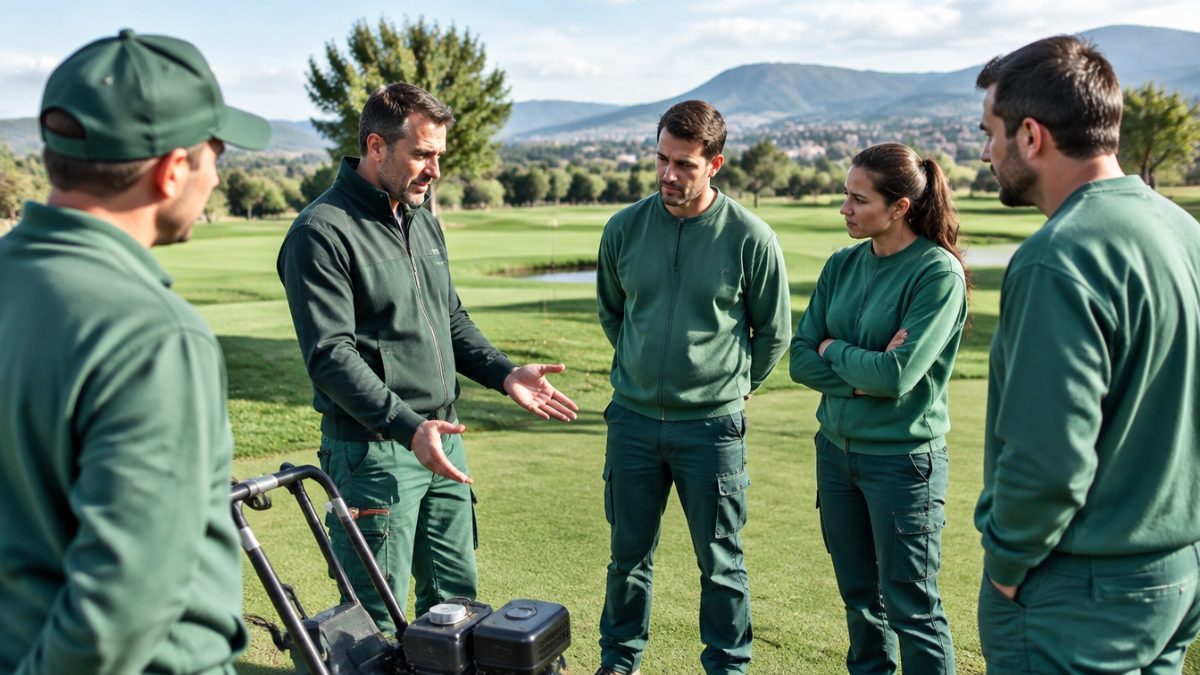
Greenkeeping staff training should not be limited to operating equipment. A good operator is also the head greenkeeper’s eyes: they know how to recognise turf under drought stress, an abnormal patch or a colour change that deserves a second look.
It is learned with real examples, walking the course in small groups and comparing:
- What a healthy green looks like compared with one that is starting to fail.
- Symptoms of drought, overwatering and compaction.
- Differences between species, such as bermudagrass, ryegrass or Poa annua, and their seasonal behaviour.
- When to report and to whom.
Within greenkeeping staff training, this block pays for itself fastest. The sooner a problem is detected, the cheaper it is to solve. Encouraging anyone to report what they see, without fear of being wrong, multiplies the course’s capacity for surveillance.
Skill 4: irrigation, product application and good practice
The fourth block covers two sensitive areas: water management and the use of plant protection products and fertilisers. In irrigation, operators must understand what each station does, how to check sprinklers and how to avoid waste. In applications, the priority is safety and compliance.
Remember that anyone applying plant protection products needs the corresponding accreditation and must act in line with the label, current regulations and the advice of an authorised technician. Greenkeeping staff training in this area includes:
- Calibration and cleaning of application equipment.
- Management of containers, leftover mix and storage.
- Recording of every application made.
Whoever receives this greenkeeping staff training understands the reason behind each rule and follows it better. Documenting what you do is not bureaucracy: it is the way to demonstrate responsible work and to learn from what has happened.
Skill 5: communication and teamwork
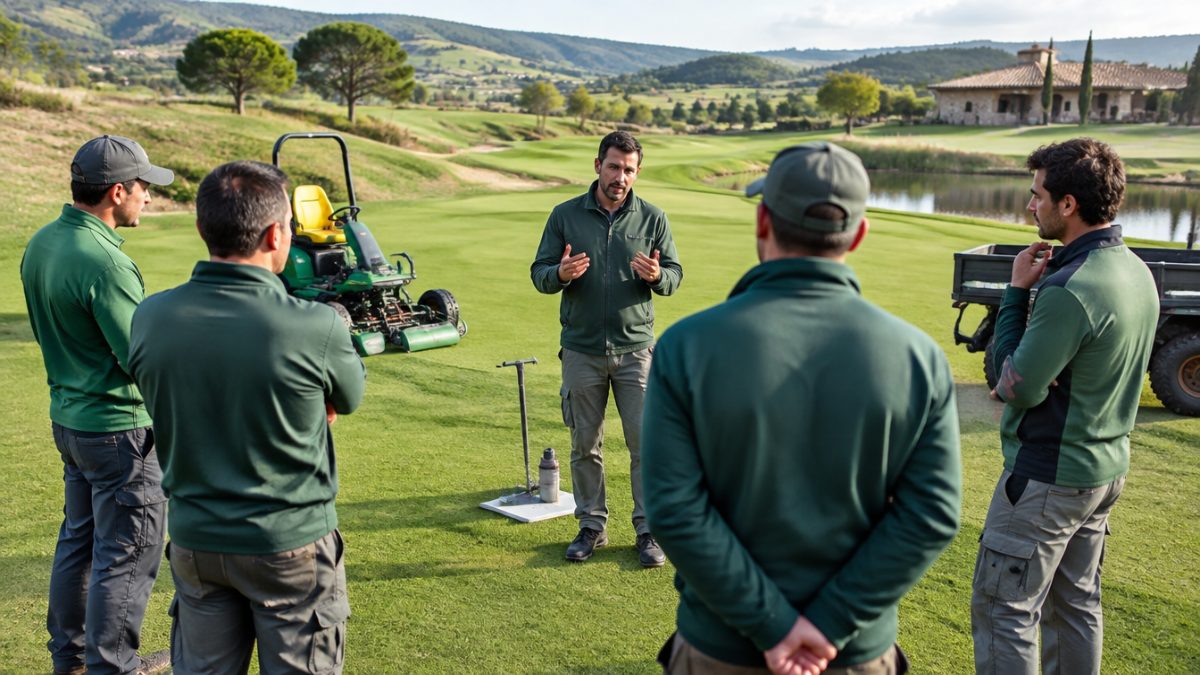
The best technical practices are diluted if the team does not communicate well. A confusing instruction, a badly completed work sheet or a message that does not arrive in time generates rework and tension. Greenkeeping staff training should also include soft skills, even if little is said about it.
Some simple practices that can be trained:
- Short start-of-shift meetings of five or ten minutes.
- Clear instructions: what, where, how and by when.
- Closing each task with a report to the person in charge.
- Respectful treatment of players, members and clubhouse staff.
On courses with a multicultural workforce or temporary staff, it is worth supporting explanations with images, diagrams and practical demonstrations so that nobody is left out because of a language barrier.
Skill 6: organising a greenkeeping staff training plan
The last skill belongs to the manager: knowing how to plan. A realistic training calendar fits into the rhythm of the course instead of competing with it. Use the off-season for the more theoretical content and the high season for short refreshers on the course itself.
A formula that usually works:
- Identify needs by job and by person.
- Set concrete objectives, such as everyone knowing how to set up a mower.
- Alternate internal sessions with courses from associations and suppliers.
- Assess through practical observation, not just attendance.
- Keep a record of what has been learned on a file for each worker.
Good greenkeeping staff training, sustained over time, turns operators into internal reference points who in turn train newcomers. Recognising progress, with more responsibility or a new role, keeps motivation up and reduces turnover, which is one of the biggest hidden costs of any course team.
Further reading: GCSAA. Professional associations such as the GCSAA offer continuing education programmes for superintendents and course teams.
Frequently asked questions
How often should greenkeeping staff training be renewed?
Ideally a short refresher at the start of every season on safety and machinery, and occasional sessions during the year according to needs. Mandatory accreditations, such as those for applying plant protection products, have their own renewal periods, which should be checked in current regulations.
How can I train course staff without stopping the work?
With short sessions built into the working day: ten-minute talks before setting out, demonstrations on the machine itself and observation walks around the course. Longer content is left for the off-season, and shifts are spread so that essential tasks are never left uncovered.
Who should deliver greenkeeping staff training?
Combine profiles: the head greenkeeper and the mechanic teach what is specific to the course, veteran operators pass on daily practice, and associations, suppliers or consultants bring an outside view. What matters is that the content is practical, adapted to the job and assessed in real work.
Keep reading
- key positions and roles in the greenkeeping team Greenkeeping team: 6 key roles and responsibilities
- skills of a good head greenkeeper Head Greenkeeper: 7 Skills of a Good Leader
- measures to prevent risks in greenkeeping Risk Prevention in Greenkeeping: 7 Practical Measures