
Almost every course with lakes has lived through that moment: a hot summer, the water turns green, foam appears at the edge and members start asking questions. Algae in golf course lakes are not just a cosmetic problem; they can clog filters, affect the quality of the irrigation water and damage the image of the course.
The good news is that they almost always have identifiable causes. In this article we review five of the most common ones and the management solutions that work best, with a preventive approach that combines design, nutrient management and regular water monitoring.
Understanding algae in golf course lakes: a symptom, not the disease
Algae are natural organisms in any body of water. The problem appears when they multiply out of control, and that happens when the system receives more nutrients, light and heat than it can balance. That is why removing algae without correcting what feeds them only offers temporary relief.
It helps to distinguish between filamentous algae, which form mats or strands, microalgae that tint the water green, and certain cyanobacteria, which can have health implications. If you suspect the latter, avoid contact with the water and its use for irrigation until you have a diagnosis from a laboratory or competent technician.
An observation routine helps a great deal. Walking the shoreline once a week, always on the same route and noting colour, smell, clarity and the presence of foam, lets you detect changes in algae in golf course lakes in time and compare them with heat, rainfall and fertiliser applications in the preceding days.
Cause 1: excess nutrients from runoff and fertilisation
Phosphorus and nitrogen are the fuel of algae. They reach the lake through runoff from fertilised roughs and fairways, through sediment washed in after heavy rain, through inflow water or through organic matter accumulated on the bottom.
The solutions start with turf management:
- Adjust the fertiliser plan to real needs, backed by testing.
- Avoid applying fertiliser just before forecast rain or heavy irrigation.
- Leave an unfertilised vegetation strip around the shoreline.
- Remove clippings and leaves that fall directly into the water.
A very effective and inexpensive measure is to change the discharge direction of mowers near the banks, so that clippings do not end up in the lake. Reviewing this kind of daily detail reduces the input of organic matter that feeds algae in golf course lakes throughout the summer.
Cause 2: poor circulation and stagnant water
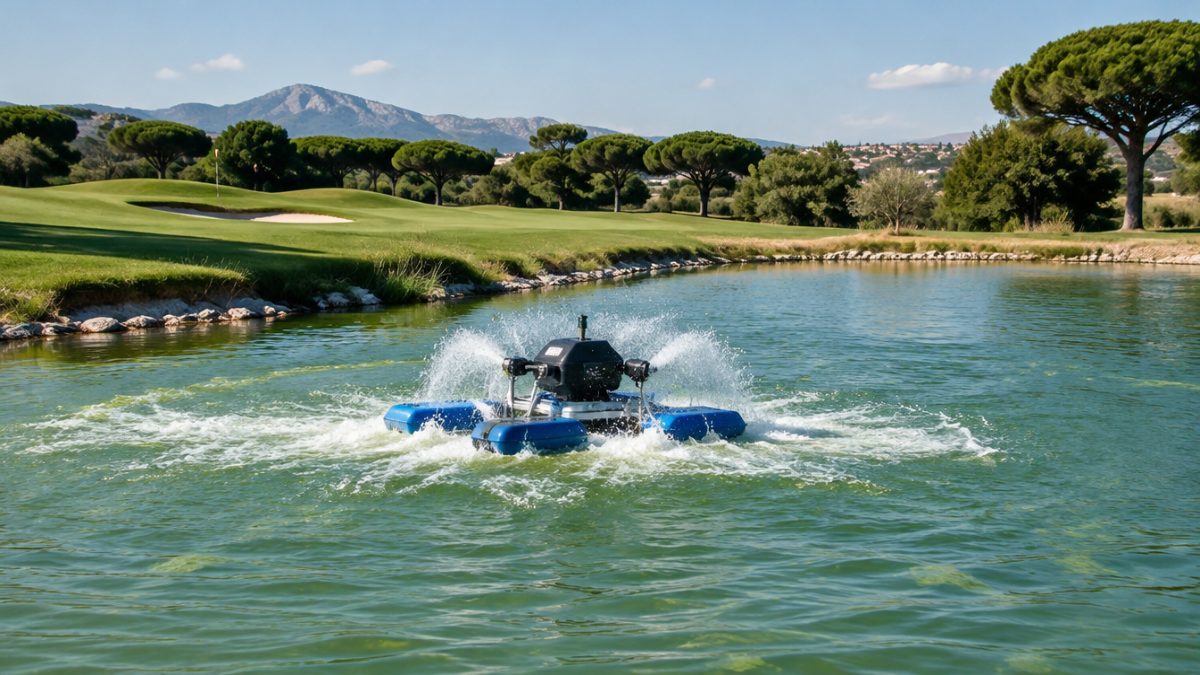
A lake with no movement becomes stratified: the upper layer heats up and the bottom loses oxygen. Under those conditions, algae proliferate and the sediment releases nutrients that had been held back. Shallow lakes and those with closed-off corners are the most exposed.
Increasing circulation and oxygenation with aerators, fountains or designs that encourage flow helps break up that stratification. Before investing in equipment, it is worth studying the shape of the lake and the water inlets and outlets, because sometimes a simple change to the flow layout does more than an expensive device. On courses with several connected lakes, it is useful to check which one gets no water renewal and start there, since it usually holds the most persistent algae in golf course lakes.
Cause 3 of algae in golf course lakes: temperature, light and shallow depth
In summer, high temperatures and intense light speed up algae growth, especially in shallow areas. The shallower the water, the faster it warms and the more light reaches the bottom, favouring mats of benthic algae.
The solutions here are about design and maintenance: deepening critical areas where feasible, creating shade with suitable bankside vegetation and avoiding lowering the level too much in the middle of the warm season. Each measure should be assessed with a technician, taking into account the regulations that apply to works and bodies of water. A common example is a shallow-edged lake that fills with green strands every July: deepening one strip and shading the south bank was enough for algae in golf course lakes to stop appearing so intensely.
Cause 4: accumulated sediment and a lack of useful aquatic vegetation
Over the years, lakes accumulate organic sludge that acts as a nutrient reserve. If aquatic or marginal vegetation that competes for those nutrients is also lacking, algae have all the advantage.
A medium-term strategy combines occasional sediment removal, planting native species on margins and in shallow areas, and control of invasive species. For algae in golf course lakes, that vegetation works as a natural filter and, incidentally, improves habitat for wildlife and pollinators. Sludge removal, on the other hand, usually requires authorisation and a management plan for the extracted material, so it should be planned well in advance and outside the busiest periods on the course.
Cause 5: poorly controlled irrigation inflows, inlets and discharges
Sometimes the problem lies in the source of the water. Runoff from neighbouring urban or agricultural areas, inflows of recycled water carrying nutrients or drainage returns can feed the lake without anyone noticing. Basic monitoring of the inflow points helps identify the origin.
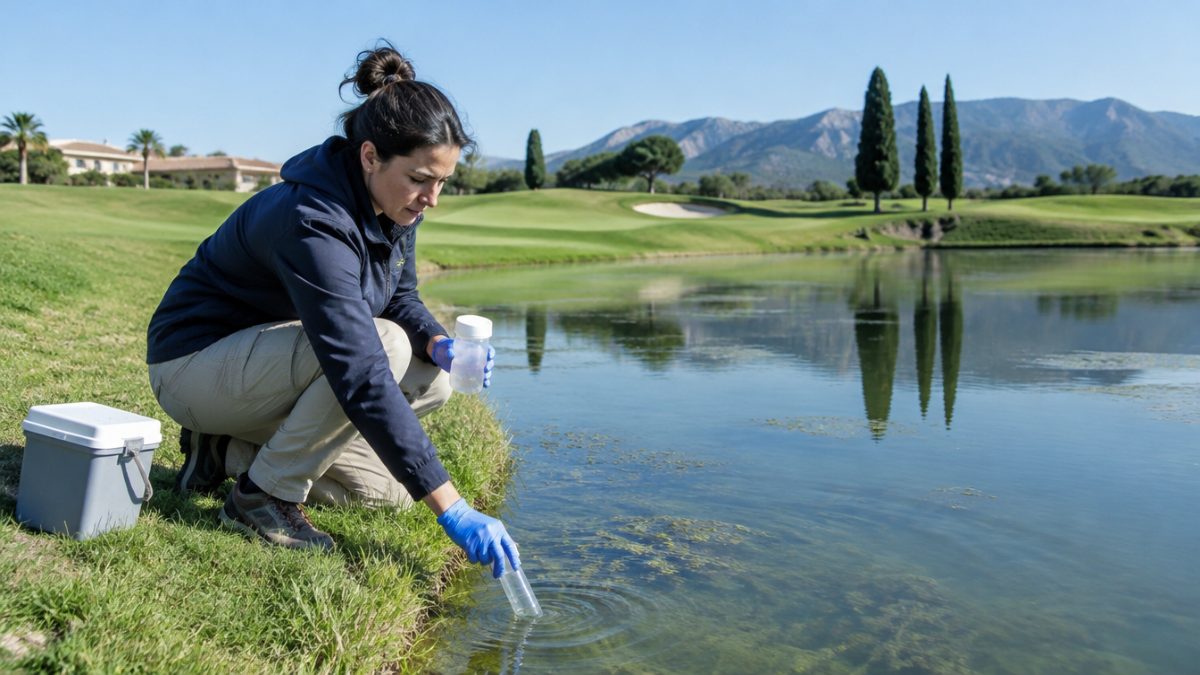
Take samples at different points and dates, note the results and compare them with bloom episodes. With that history, algae in golf course lakes stop being a surprise and become a predictable event. As for algaecide treatments, they should only be considered with the advice of an authorised technician, following the label and current regulations, and assessing their effect on wildlife and water quality.
Further reading: FAO. The FAO publishes documentation on water quality and water resource management that serves as a general framework for reference.
Frequently asked questions
Why do algae appear in golf course lakes in summer?
Because of the combination of heat, intense light, shallow or stagnant water and nutrient availability. When these factors coincide, algae multiply quickly. That is why prevention focuses on reducing phosphorus and nitrogen inputs, improving circulation and monitoring water condition before the problem becomes visible.
Are algae in golf course lakes dangerous for irrigation?
They can clog filters, nozzles and pumps, and in some cases there are cyanobacteria with health implications. If the water looks suspicious, the prudent course is to avoid contact, suspend its use until you receive a diagnosis from a laboratory or technician, and review the filtration system and irrigation lines.
How often should I check for algae in golf course lakes?
Ideally, carry out frequent visual inspections, especially in the warm months, and complement them with periodic sampling of basic water parameters. The sooner a change in colour, smell or clarity is detected, the easier it will be to correct it with management measures without resorting to drastic solutions.
Keep reading
- recycled water for irrigation Reclaimed Water for Irrigation: 6 Keys for Your Course
- evapotranspiration and irrigation requirements Evapotranspiration in golf: 5 keys to watering just right
- pollinators on golf courses Pollinators on Golf Courses: 5 Simple Ways to Help Them