

You can have the best-calibrated sprayer in the workshop and still apply badly. The last link in the chain is the nozzle, and droplet size, working width and drift all depend on it. Choosing well between the different types of spray nozzles is one of the most cost-effective and least glamorous decisions in a course’s machinery.
In this article we review five types of nozzle used in greenkeeping, which areas of the course they suit best, which usage mistakes are common and how to organise their maintenance so they stop being the spare part that only gets changed when something goes wrong.
What Spray Nozzles Do in Every Application
A nozzle turns the pump’s flow into a fan or cone of droplets. Depending on its design, that distribution changes in three respects: the flow rate delivered at a given pressure, the angle of the spray and the droplet spectrum, that is, the proportion of fine, medium and coarse droplets.
Fine droplets cover the surface better but drift easily in even a little wind. Coarse ones stay where they should, although they can run off the leaf and leave less coverage. With spray nozzles you must always look for a balance, and that balance changes with the product, the area and the day’s weather. A good head greenkeeper knows the spray nozzles fitted to each machine and why they were chosen, not just what colour they are.
Standard Flat Fan: The Option for Fairways and Rough
The flat fan nozzle is the most widespread and, used well, the most versatile. It spreads the liquid in an elongated band with more flow in the centre, so it requires a correct overlap between adjacent nozzles on the boom to avoid streaks.
It suits large surfaces where working speed is the priority: fairways, rough and big tee boxes. Its weak point is that at high pressures or with worn nozzles it produces many fine droplets and increases drift. Among general-purpose spray nozzles, this is the one that wears most simply because of the sheer number of working hours. Work within the pressure range the manufacturer recommends and do not raise it to compensate for excessive travel speed.
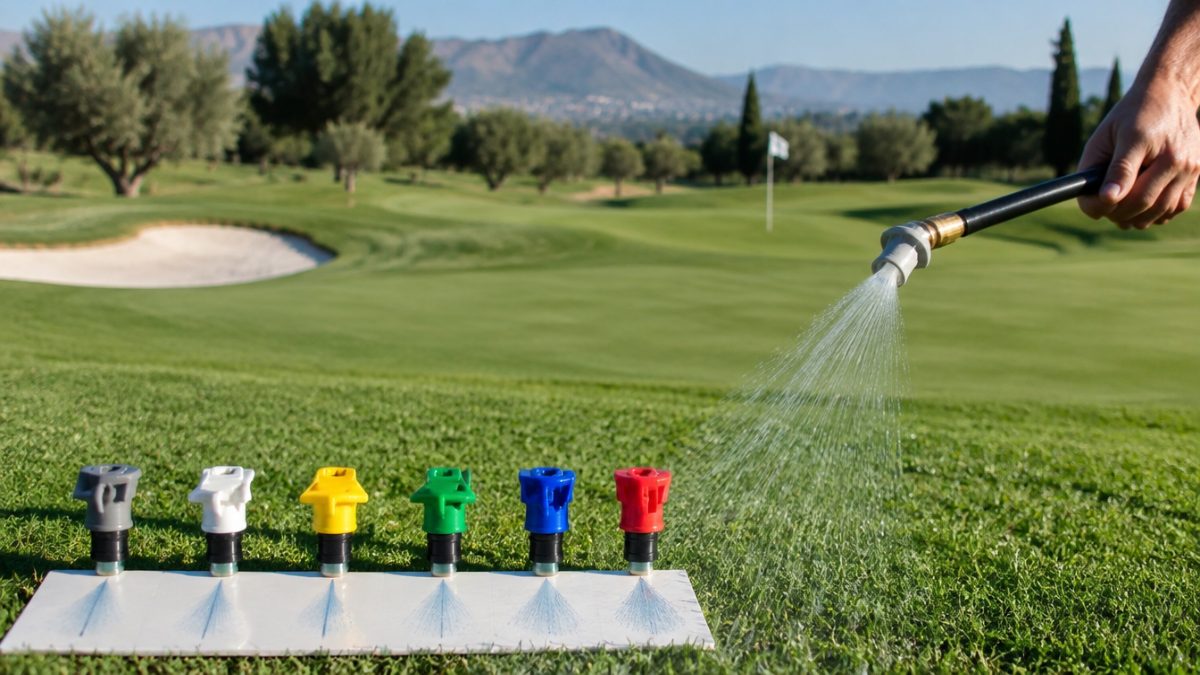
Drift-Reduction and Air-Induction Nozzles for Windy Days
Drift-reduction and air-induction nozzles produce coarser droplets, filled with tiny air bubbles that make them lighter on impact. The result is less risk of the product ending up outside the target area, which is very important near lakes, naturalised areas, gardens or neighbouring land.
In return, they give poorer coverage on fine leaves, so they are not always the best choice for contact products. A practical criterion: use them in exposed areas, with moderate wind or with sensitive margins, and compensate with an adequate spray volume. Before making their use general, test on water-sensitive paper and check the real coverage. This type of spray nozzle usually costs more, but the drift reduction pays off in delicate areas. If the course has lakes or naturalised areas near the fairways, consider dedicating a full set exclusively to those zones.
Twin Fan and Hollow Cone for Greens and Dense Targets
On greens, where the leaf is dense and low, coverage rules. Twin fan nozzles throw two streams angled forwards and backwards, which improves distribution over the vertical part of the plant. Hollow cone nozzles produce finer, more uniform droplets and are used when good penetration into the canopy is needed.
Both call for careful handling: more fineness means more drift and more sensitivity to pressure. That is why, for applications on greens, it pays to combine moderate pressure, a low boom and a stable working height. With this type of spray nozzle the boom height is key: too high and the fans overlap badly and drift increases. The product label, current regulations and the judgement of an authorised adviser must always be followed.
Low-Pressure Fan and Edge Nozzles for Perimeters
Some jobs are not full-boom: bunker edges, lake perimeters, paths or specific spots. For these, edge nozzles are used, which direct the spray to one side only, along with low-pressure wide-angle nozzles that distribute without raising a mist.
It is worth having a small identified kit for these uses, rather than improvising with the nozzles from the main boom. Having specific spray nozzles for these uses also makes the work easier for less experienced staff, who do not have to decide on the fly. That avoids someone fitting a worn part or one with a different flow rate and reduces the risk of overlaps, double rates or untreated areas.
Colour Coding, Wear and Regular Inspection
Most spray nozzles follow a colour code according to their nominal flow rate. It is an excellent aid, but only if the whole team knows it and it is respected. A couple of simple rules help a lot:
- Always fit nozzles of the same type, size and condition on the boom.
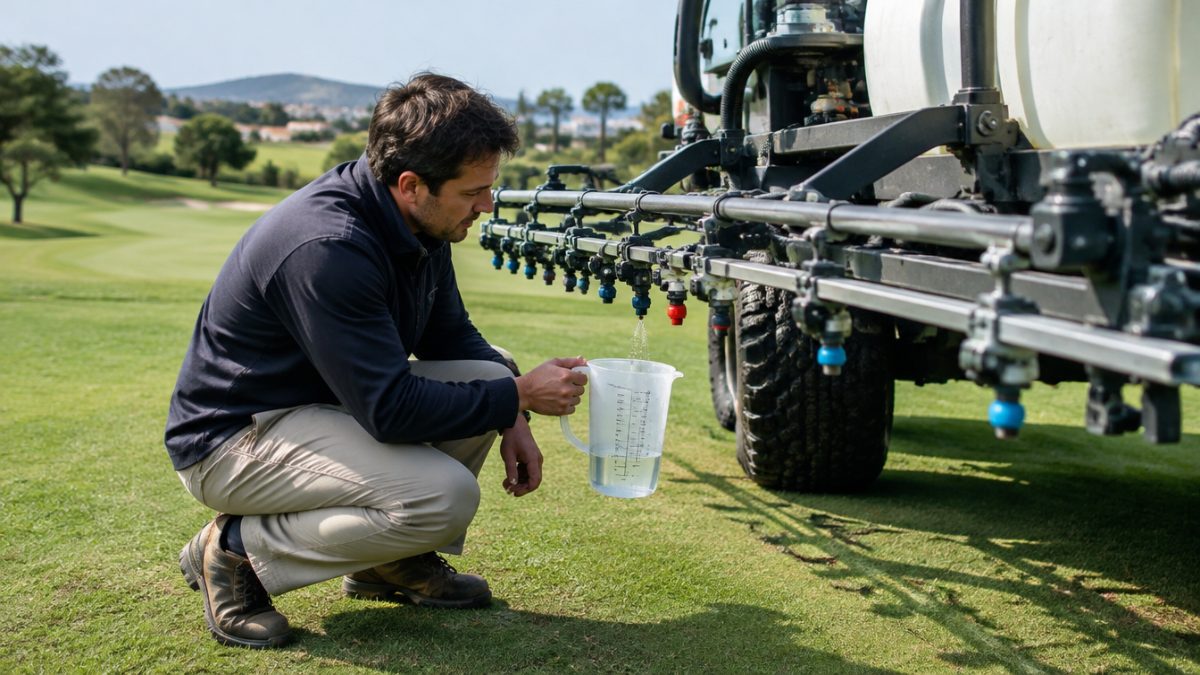
- Measure the output of each nozzle with a measuring jug and replace any that deviate appreciably from the nominal value.
- Clean with a soft brush and water, never with wire or hard objects that deform the orifice.
- Check filters and filter holders, because a partial blockage alters the fan without being visible to the naked eye.
Note the date of each change and the type fitted, just as you do with the other parts of the machine. Without that record, inspection of spray nozzles depends on the memory of whoever fitted them. It also becomes impossible to know whether an uneven application came from the nozzle or from another factor.
Further reading: GCSAA. The superintendents' association GCSAA publishes training resources on product application and good spraying practices that are worth consulting.
Frequently asked questions
How often should spray nozzles be changed?
There is no universal interval, because wear depends on hours of use, pressure and the products applied. The sensible approach is to measure each nozzle's output periodically with a measuring jug and replace them when they deviate from the manufacturer's nominal value, and also to check them whenever streaks or uncovered areas are noticed.
Can the same spray nozzles be used on greens and fairways?
Usually not. On fairways working width and speed are the priority, and on greens, coverage over dense leaf and fine drift control. Having sets identified by area avoids fitting errors and lets you adjust pressure and spray volume sensibly, always following the label of the product used.
How do I know if my spray nozzles are worn?
The clearest signs are a flow rate above nominal, an uneven fan with more or less wet bands and visible streaks after application. A simple test is to spray water onto a smooth surface and observe the pattern, or to collect the output of each nozzle for one minute and compare it with the rest of the boom.
Keep reading
- how to calibrate the sprayer step by step Sprayer Calibration: 6 Steps to Accurate Rates
- preventive maintenance of course machinery Preventive Equipment Maintenance: 7 Key Tasks
- plant protection treatment records Pesticide Application Records: 6 Key Data Points