
Few species divide greenkeepers as much as Poa annua. For some it is a weed that ruins uniformity; for others, a turf that with good management can offer excellent surfaces. The truth is that it is present on a great many courses, reproduces easily by seed and is never completely eliminated in one go.
The realistic goal is to control it, that is, to prevent it from dominating where it should not and from competing with the main species. These six strategies for controlling Poa annua on greens combine cultural, irrigation, nutrition and monitoring criteria so you can organise your work plan.
Get to Know the Poa annua on Your Course
The first step in controlling Poa annua is to understand how it behaves on your course. There are annual and perennial forms, with different growth habits and tolerances. Some produce seed massively in spring and leave yellowish patches and uneven surfaces; others behave more steadily.
- Map its presence on each green: where it is, at what density and at what times of year it appears.
- Observe whether it concentrates in wet, compacted, shaded or high-traffic areas.
- Distinguish whether it is a recent invasion or already a stable part of the cover.
That information sets the direction, and it pays to update it every season because the distribution changes with the climate and with management. Reducing an occasional presence is not the same as living with a mostly Poa annua green, where the objective changes.
Reduce the Conditions That Favour Poa annua
Poa annua thrives with constant moisture, compaction, excess nitrogen and very low cutting heights. Often, control starts with no longer giving it what it likes. If you reduce these advantages, the main species recovers ground naturally.
- Avoid waterlogging and improve surface and subsurface drainage.
- Relieve compaction with periodic aeration adapted to the condition of the green.
- Moderate concentrated traffic on collars and approaches by rotating entry and exit points.
- Review the cutting height: lowering it too much favours Poa annua over other species.
This approach, sustained over time, gives longer-lasting results than any one-off intervention.
Adjust Irrigation to Control Poa annua on Greens
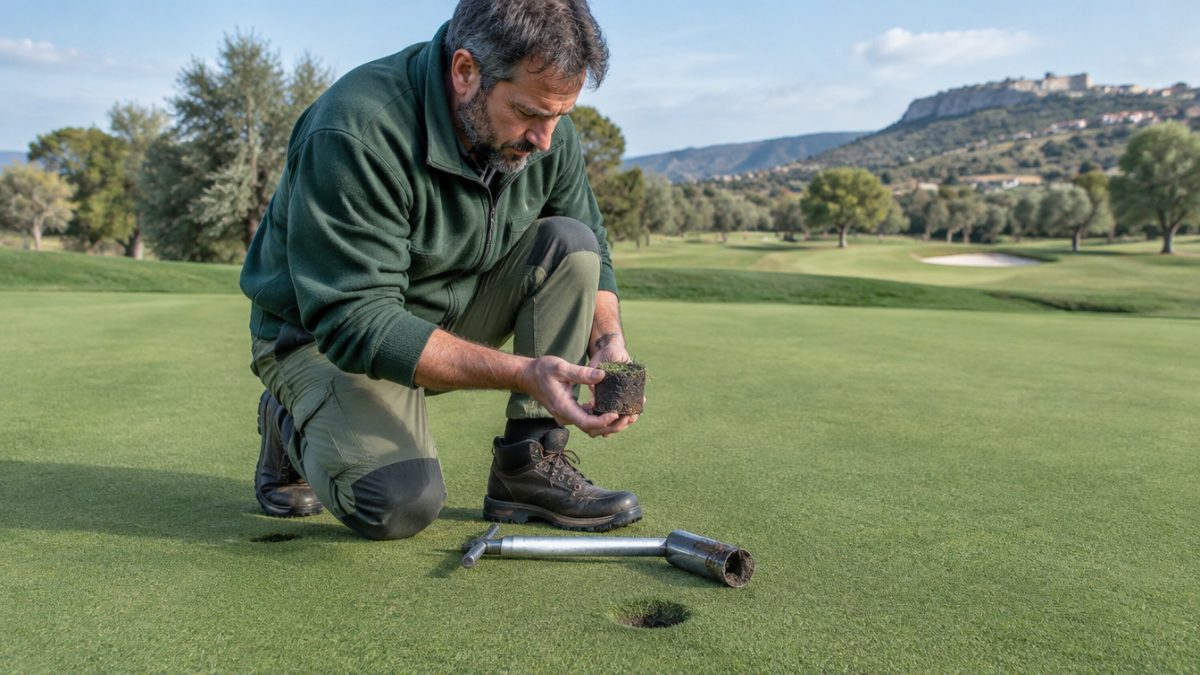
Irrigation is one of the most powerful levers. A green irrigated frequently and lightly keeps a permanently moist surface layer, exactly what favours the germination and rooting of this species. Deeper, more spaced irrigation, adapted to real demand, creates a less favourable environment.
- Irrigate according to profile moisture, not according to the calendar.
- Avoid unnecessary afternoon and night irrigation that leaves the foliage wet for hours.
- Correct areas with excess water caused by overlaps, worn nozzles or slopes.
Combining the moisture probe with field observation helps irrigate precisely. The result is healthier turf, with deep roots and greater competitiveness against the invader. Pay attention to transition periods, when rain and heat alter soil moisture and it is easy for the irrigation schedule to stay out of tune for weeks.
Plan Nutrition to Favour the Main Species
Abundant nitrogen favours the fast growth of Poa annua, especially in spring and autumn. Adjusting fertilisation to what is strictly necessary, with lighter and more frequent inputs, and watching the balance of other nutrients, helps tip the competition in favour of the desired species.
- Rely on soil and tissue analysis to avoid excess.
- Avoid large nitrogen inputs before the germination and flowering peaks.
- Check the pH and soil conditions, which influence which species competes best.
Record each application and watch how the proportion between species evolves. If you do not measure, it is easy to think the plan is working when reality is different. A simple count, by quadrants or by photograph, is enough to know whether the proportion rises or falls between one season and the next, and to decide whether the nutrition effort is bearing fruit.
Aeration, Thatch and Flowering: Key Cultural Practices
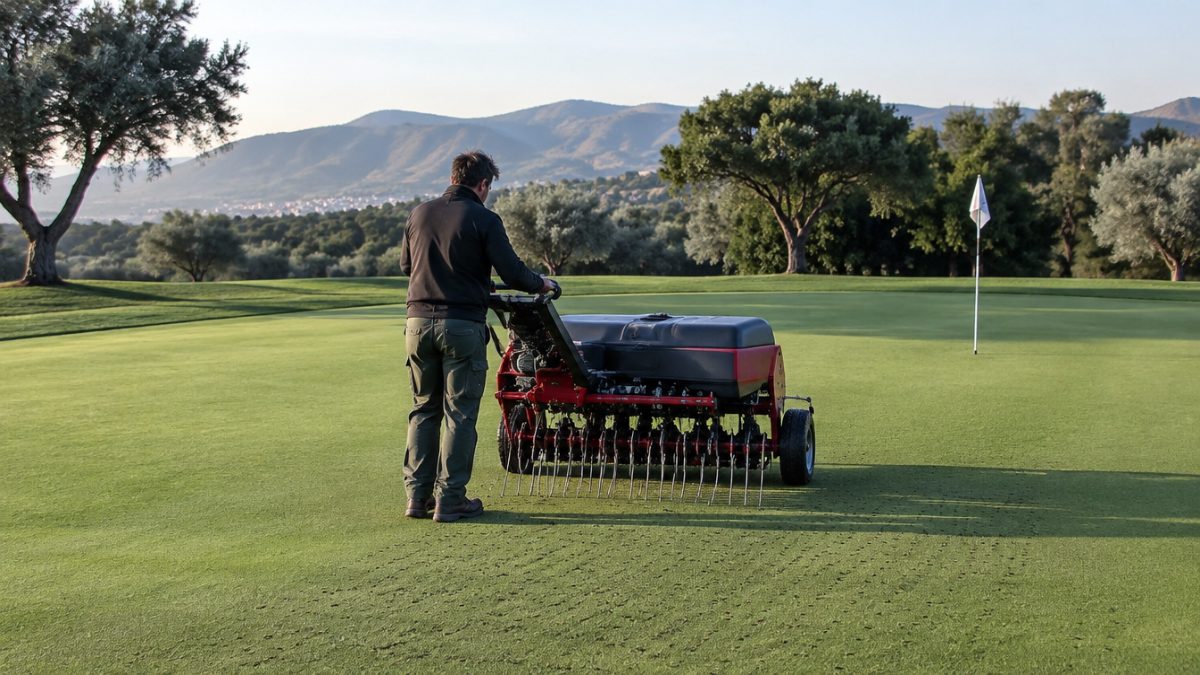
An excessive thatch layer holds moisture, hinders drainage and creates an excellent bed for germination. Controlling organic matter with regular top-dressing, verticutting and aeration keeps the profile more open and firm. In addition, frequent, well-sharpened mowing reduces seed production and dispersal.
- Schedule thatch control operations before the flowering peaks.
- Consider mowing with clippings collected during flowering, to limit seed dispersal.
- Clean machines when moving from an infested green to a clean one so as not to carry seed.
When the use of growth regulators or herbicides is considered, the decision must be made by an authorised adviser, always following the label and current regulations, and recording each application. No product replaces cultural management: without it, the invader returns. And do not forget to repair the gaps that any intervention leaves, because an uncovered gap in autumn is an invitation for new seeds to germinate.
Monitor and Set Realistic Goals
Controlling Poa annua on greens is a job of years, not weeks. It pays to set realistic goals and review them often. Reducing the proportion a little each season is already a success, and maintaining surface uniformity can be a more reasonable goal than eradication.
- Photograph the same points on each green regularly.
- Note flowering dates, applications and cultural practices.
- Share the results with management and the green committee in clear language.
With that information you will be able to adjust the plan every year and justify why certain decisions, such as slightly raising the cutting height or reducing nitrogen, are worthwhile even if in the short term they seem contrary to what some players ask for.
Further reading: STRI. To learn more about the management of turfgrass species and research on sports surfaces, you can consult the technical information from the STRI institute.
Frequently asked questions
Can Poa annua be completely eliminated from greens?
In practice it is very difficult, because it produces a lot of seed and that seed can remain viable in the soil for years. The realistic goal is to control it: reduce its proportion, prevent it from dominating and maintain a uniform surface through constant cultural management, with an adviser's support when treatments are considered.
What should I do if my green is already mostly Poa annua?
Change the approach: instead of eradicating it, adapt management to that species. This usually calls for adjusted irrigation, disease monitoring, prudent cutting heights and more attention in summer. What matters is achieving a consistent, stable surface, with a clear and recorded work plan.
What maintenance reduces Poa annua most effectively?
Control of surface moisture, reduction of compaction and thatch, moderate nutrition and well-sharpened mowing are the basis of Poa annua control. On their own they give lasting results; chemical treatments, if used, should be a complement and not the main strategy.
Keep reading
- How to control thatch on greens Thatch in greens: 6 warning signs and how to reduce it
- Integrated pest management on the course Integrated pest management in golf: 6 key steps
- Fusarium in turf: prevention and management Fusarium patch in turf: 5 winter measures