
Many clubs discover the importance of their water rights at the worst moment: a drought, an inspection, a sale of the property or a change of management. Suddenly nobody knows for certain which title covers irrigation, what volume is authorised or what monitoring obligations must be met.
This article does not replace legal advice, but it helps you set out the right questions. We review five key points on water rights in golf from the perspective of the person managing the course: which documents to locate, which data to monitor and how to coordinate with management and with legal and technical advisers.
Water rights in golf: the source of the water and the title that covers it
The first step in any analysis of water rights in golf is to know where every cubic metre used comes from and under what title. Not all sources are regulated in the same way, and the situation may be mixed within the same course.
- Surface or groundwater, with their corresponding authorisations, concessions or registrations.
- Municipal mains supply or an irrigation community, with its contractual conditions.
- Reclaimed water from a wastewater treatment plant, with its own agreements and quality requirements.
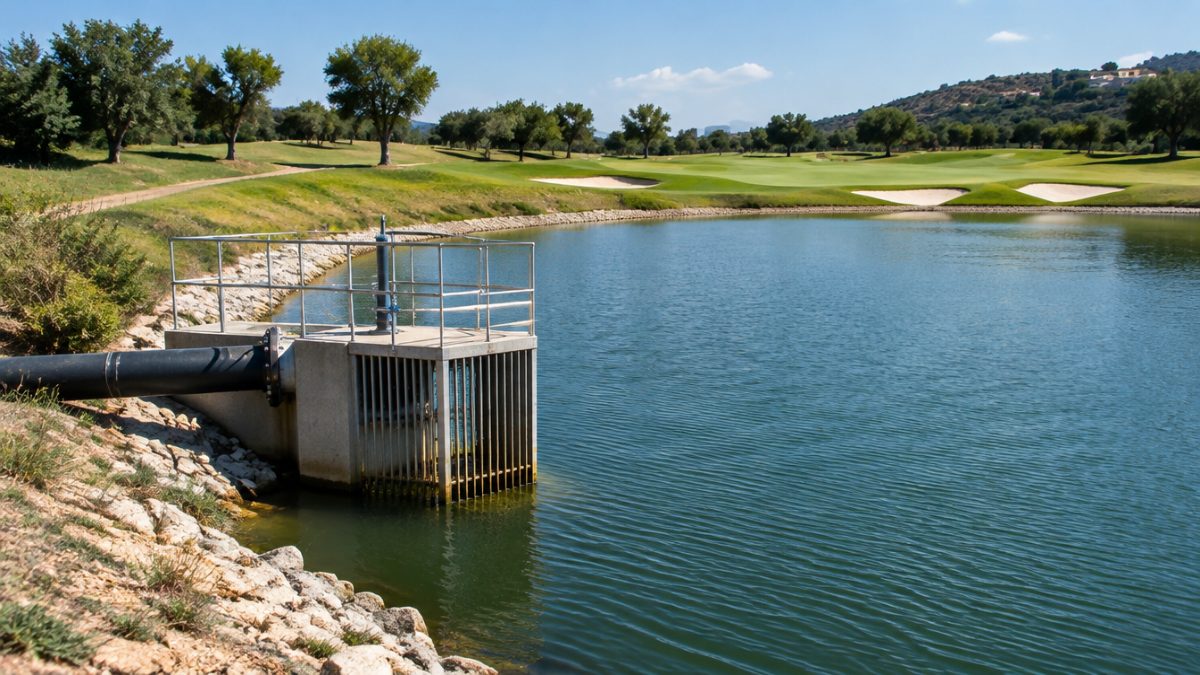
- Runoff or the course’s own abstractions collected in reservoirs.
Many disputes over water rights in golf arise because the title is in the name of a former company or because the real source does not match the one on paper. It pays to draw up a record for each source with the holder, the document covering the use, the date, the competent authority and its validity status.
Review volumes, authorised uses and conditions
Having a title does not mean having total freedom. Water rights in golf usually carry conditions on the maximum volume, permitted use, point of abstraction, flow rate or period of use. Comparing what is authorised with what is actually consumed is a basic check that many clubs do not make, and it should be part of any review of water rights in golf.
- Compare the authorised annual volumes with the recorded consumption.
- Check that the actual use (course irrigation, landscaping, facilities) matches the authorised use.
- Check whether there are quality conditions, drought limitations or temporary restrictions.
If the course has grown, changed layout or added new facilities, verify that the title still fits reality and consult an adviser.

Monitor and measure consumption rigorously
Almost all modern titles involve some obligation to measure or to provide data to the authorities. Without reliable meters and regular readings, it is impossible to show that what is authorised is being complied with. And without data, the course cannot be defended against a restriction either.
- Install or verify meters at each abstraction point and at the inlets to reservoirs.
- Calibrate or check the meters as often as current regulations require.
- Record readings with the date, person responsible and observations.
- Cross-reference consumption with scheduled irrigation to detect leaks or deviations.
A well-done irrigation audit helps distinguish between what is consumed and what the turf really needs, valuable information in any review.
Prepare the documentation and renewal deadlines
Water rights in golf are not forever: many titles have terms, renewal conditions and periodic obligations. Missing a deadline can have serious consequences, and it is common for the knowledge to sit with one person or in an old file.
- Centralise copies of resolutions, contracts, payments of fees or tariffs and communications with the authorities.
- Note expiry, review and data submission dates in a calendar.
- Appoint one person responsible and another as backup, so as not to depend on a single individual.
- Keep the documentation for works and modifications made to intakes, reservoirs and pipelines.
An orderly file of water rights in golf is decisive in a sale, an audit or a change of ownership, and also for planning irrigation investments with full knowledge.
Prepare for droughts and temporary restrictions
In a Mediterranean climate, restrictions on water use are a possible scenario and not a rarity. Water rights in golf can be affected by temporary limitations, priorities of use between sectors or reductions in available volume. Anyone who reaches a drought without a plan is forced to decide under pressure.
- Prepare a contingency plan with priority areas, such as greens and tees, and areas that can be sacrificed.
- Define with management what level of reduction is acceptable and what communication will go out to members.
- Work with the team on how to keep the turf alive with less water, without compromising its survival.
- Document which water-saving measures are already in place, because they help defend the club’s position before the authorities.
A course that shows efficient use with data has more arguments when allocation and priorities are discussed.
Coordinate management, greenkeeper and specialist advisers
The greenkeeper knows the consumption and the real needs of the turf; management knows the contracts and the club’s strategy; the legal and technical adviser knows the legal framework and procedures. Water rights in golf are managed best when all three talk before a problem arises.
- Share periodic consumption reports and forecasts of needs with management.
- Consult a legal adviser before any change of use, expansion or transfer of the property.
- Keep up regular contact with the competent bodies and with the irrigation community, if applicable.
- Explore efficiency strategies that reduce dependence on a single resource: deficit irrigation, uniformity improvements, reclaimed water.
Anticipating restrictions is always cheaper than improvising during a drought.
Further reading: MITECO. Spain's Ministry for the Ecological Transition (MITECO) provides general information on the management of the public water domain and the obligations of water users.
Frequently asked questions
What are water rights in golf?
They are the titles and authorisations that cover the use of water to irrigate the course and supply the facilities: concessions, authorisations, supply contracts or agreements for reclaimed water. Each type carries its own conditions on volume, use and monitoring. It is advisable to consult a legal adviser to understand the specific situation of each club and its documentation.
What documents should the club have to hand?
At a minimum, the titles or contracts covering each source, plans of the intakes, consumption records, proof of payments and communications with the authorities. Also the authorisations for works on abstractions and reservoirs. Having these documents in order makes any inspection easier, as well as the defence of the club's water rights in golf.
Can the use of water change without consultation?
It is not advisable. Changing the point of abstraction, the volume, the type of use or the ownership may require authorisation or notification to the authorities. Before expanding the course, installing new irrigation areas or modifying reservoirs, consult a legal and technical adviser, so as not to put at risk the water rights in golf already acquired.
Keep reading
- Irrigation audit: how to do it Irrigation audit: 7 steps to detect water losses
- Reclaimed water for irrigation on golf courses Reclaimed Water for Irrigation: 6 Keys for Your Course
- Deficit irrigation: when and how to apply it Deficit Irrigation in Golf: 5 Rules for Applying It