
Few tasks transform a green as much as a good topdressing programme. Done well, topdressing greens corrects irregularities, dilutes thatch and keeps the surface smooth and firm all year. Done badly, it only dirties the cylinders, slows the ball and leaves the turf looking dull for weeks.
Here are seven keys to planning and carrying out topdressing greens with good judgement: from choosing the sand to follow-up afterwards, including rate, timing and working it into the soil. These are general principles that each course must adapt to its species, profile and climate.
Define the objective of topdressing greens
Before preparing the machine, answer one question: what do we want to achieve? A light maintenance topdressing is not the same as one meant to level, dilute organic matter or accompany an aeration. The objective determines the rate, frequency and calendar.
- Maintenance: light, frequent applications to preserve smoothness and control the organic layer.
- Levelling: working on small hollows, pitch marks or traces of earlier work.
- Supporting other tasks: filling the holes after spiking, aeration or scarifying.
Writing the objective of each topdressing on the work order helps you evaluate afterwards whether it has been achieved.
Choose a sand compatible with your profile
Topdressing sand must be compatible with the sand in the green’s profile. If the particle size differs greatly, layers form that slow drainage and encourage water and rooting problems. It is best to ask the supplier for analyses, compare them with those of the actual profile and keep the same source whenever possible.
- Washed sand, with rounded to subangular particles and free of fines and clay.
- Stable particle size between batches; ask for samples before each large order.
- Dry material at the time of application, stored under cover.
- Avoid improvised mixes with soil or compost without prior analysis.
A periodic soil analysis of the top of the green’s profile helps verify that topdressing greens is maintaining the physical properties you are after.
Match rate and frequency to turf activity
The general rule in a topdressing greens programme is a few heavy applications versus many light ones: the second option almost always wins. A thin layer is absorbed within a few days, protects the crown and barely alters playability. A thick layer buries the turf, delays recovery and forces insistent brushing.
As a rough guide, frequency goes up when the turf is growing vigorously and down when it is slow or dormant. A bentgrass green in active growth can take more frequent applications than a bermudagrass green in the depths of winter.
- Watch whether the sand disappears quickly or stays on the surface.
- Reduce the rate under heat or water stress.
- Avoid topdressing just before events if there is no time to recover.
Choose the timing and the weather
The best date for topdressing greens is when the turf is growing enough to hide the sand within a few days and the soil allows work without mud. The weather rules: with heavy dew or rain, sand cakes and does not flow; with strong wind, it spreads badly and drifts.
- Schedule the job for hours when the leaf is dry.
- Check the forecast for the next 48 hours to make sure you can irrigate and brush.
- Avoid intense heatwaves, when the added stress penalises recovery.
- Coordinate the date with the competition calendar and notify management.
Spread evenly and measure the rate
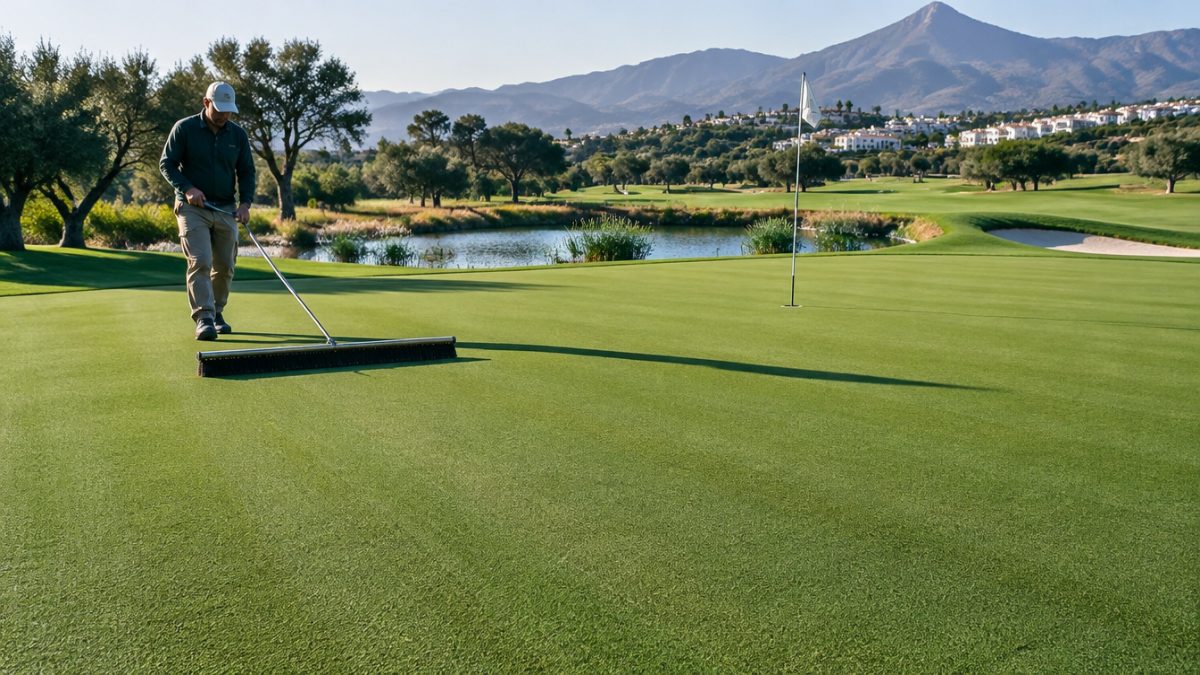
Spreading is where the result is won or lost. The equipment must be calibrated and operators trained to keep speed and pass pattern constant. A well-adjusted machine such as a topdresser leaves an even layer; with careless settings, bands and piles appear.
- Calibrate over a tarp or trays before going out to the green.
- Keep a pass pattern that avoids overlaps and gaps.
- On steep slopes or collars, reduce the load and adjust the travel.
- Record the rate applied to each green so you can repeat or correct it.
After application, a quick check of the green by eye and on foot detects spots with too much or too little sand that should be corrected straight away.
Work the sand in: brushing, rolling and irrigation
Sand left on top of the leaf is no use. Topdressing greens needs an incorporation phase that brings it down to the soil, with brushes, drag mats, a roller and light irrigation. If it is omitted, the sand dulls the cylinders, is dragged along by the mowers and leaves the green rough.
- Brush dry, with just enough pressure not to damage the plant.
- Apply a light settling irrigation when appropriate.
- Check the cutting height in later mowings and monitor the condition of the cylinders.
- Consider light rolling to consolidate the surface.
After the job, check that the edge of the blades has not suffered, since sand wears them faster than it seems.
Record and evaluate every topdressing of greens
A programme of topdressing greens without records is very hard to improve. Noting what was applied, when, where and with what result lets you know whether thatch is dropping, whether the surface is improving and whether the cost is justified. It also helps explain to members and the committee why there are days when the green is a little slower.
- Date, rate, green or area, operators and machines used.
- Weather conditions and turf condition on the day of the job.
- Observations on speed, firmness and appearance in the following days.
- Incidents: blade wear, marks, player complaints.
With this information, each season starts from an objective base and not from memories.
Further reading: STRI. Research institutions such as STRI offer reference technical information on the construction and maintenance of turf sports surfaces.
Frequently asked questions
How much sand should be applied when topdressing greens?
It depends on the objective and on turf activity, but the general trend is to apply thin layers that the turf can cover within a few days. Adjust the rate to the species, the condition of the green and the time of year, and avoid thick layers that bury the leaf. It is best to calibrate the machine and record the quantity applied each time.
Will any sand do for topdressing greens?
No. It must be clean, washed sand with a particle size compatible with that of the green's profile, because abrupt changes create layers that alter drainage. It pays to ask the supplier for analyses, keep the same source and check periodically that the material still meets the original specifications.
Why does topdressing greens wear the cylinders?
Sand is abrasive, and if it stays on the leaf it passes through the blades in the following mowings, dulling them early. Good incorporation with brushing and light irrigation reduces the problem. Even so, it is wise to check the edge and the adjustment of the mowers after each topdressing.
Keep reading
- Thatch in greens: how to control it Thatch in greens: 6 warning signs and how to reduce it
- Rolling greens: when and how Rolling Greens: 5 Benefits for Green Speed
- Topdresser: adjustments for even sand spreading Topdresser: 5 Adjustments for Even Sand Spreading