

Greens get a lot of attention, but players spend a good part of the round looking at the ground of the golf fairways. A dense, uniform, well-cut fairway gives a clean lie on the turf; an uneven fairway, with bare patches and blemishes, shows from the first hole and costs more money to correct than to maintain properly.
Here we review six keys to sustaining quality maintenance without letting costs spiral: how to define the level of service, when and how to mow, how to adjust nutrition and irrigation, which aeration operations pay off and how to keep orderly control of everything done in each area.
Define the level of service you expect from your golf fairways
Before talking about machines or products, it is worth answering an awkward question: what quality do you want to offer, and how much can be sustained with the budget and team available? A tournament course, a resort with heavy traffic and a members’ club with few daily tee times do not demand the same.
Writing down that level of service avoids arguments. A good starting point is to specify:
- The target cutting height and its acceptable tolerance.
- The degree of colour and density uniformity sought.
- The lie conditions in winter and summer.
- The days when the fairway must be at its best, for example competitions.
With that reference, the team knows what is expected and the committee understands why a premium fairway costs more than a functional one.
Mow with judgement: height, frequency and pattern
Mowing is the task most often repeated and the one most noticed. On bermudagrass or paspalum fairways, low heights are usually used with well-sharpened, well-adjusted cylinders; on ryegrass swards or winter mixes, somewhat greater heights. What matters is not copying a figure but holding the chosen height consistently and adapting it to the growing season.
Some useful guidelines:
- Never remove too much leaf at once; if growth surges, it is better to shorten the interval than to cut right down in one go.
- Change the mowing pattern so you do not always lay the grain in the same direction.
- Check sharpening and bedknife settings regularly; a torn cut opens the door to disease and dulls the colour.
- Return clippings to the turf when there are few, or remove them if there is an excess or disease is present.
Well-mown golf fairways need fewer corrections afterwards.

Adjust nutrition to grow just enough
On golf fairways, the aim is not maximum growth but sufficient density and reasonable recovery after play. Too much nitrogen increases mowing, thatch and disease susceptibility; a shortfall leaves the fairway weak, yellowish and open to weeds.
Plan fertilisation from soil analysis and observation of the course, and spread the inputs across each species’ growing season. Warm-season species respond in spring and summer; cool-season ones mainly in autumn and spring. Taking into account the nutrients in the irrigation water avoids doubling up on effort.
It is worth paying attention to micronutrients and pH, because an underlying imbalance can produce symptoms that are mistaken for lack of fertiliser. When in doubt, a leaf analysis usually clarifies more than another pass of fertiliser.
Irrigate efficiently and uniformly
Golf fairways cover a huge area and usually account for a good part of the course’s water use. Uneven irrigation, with poorly calculated overlap or worn nozzles, produces dry areas next to waterlogged ones, and both end up as turf problems.
To get more out of the water available:
- Check coverage uniformity with simple catch-can tests.
- Replace worn nozzles and fix tilted or sunken sprinklers.
- Irrigate less often and more deeply where the soil allows, to encourage deep roots.
- Adjust run times by zone according to evapotranspiration, soil type and exposure.
Areas with shade, slope or compacted soils do not behave like the rest, and deserve their own programmes. Noting which zones need the most attention saves time every summer.
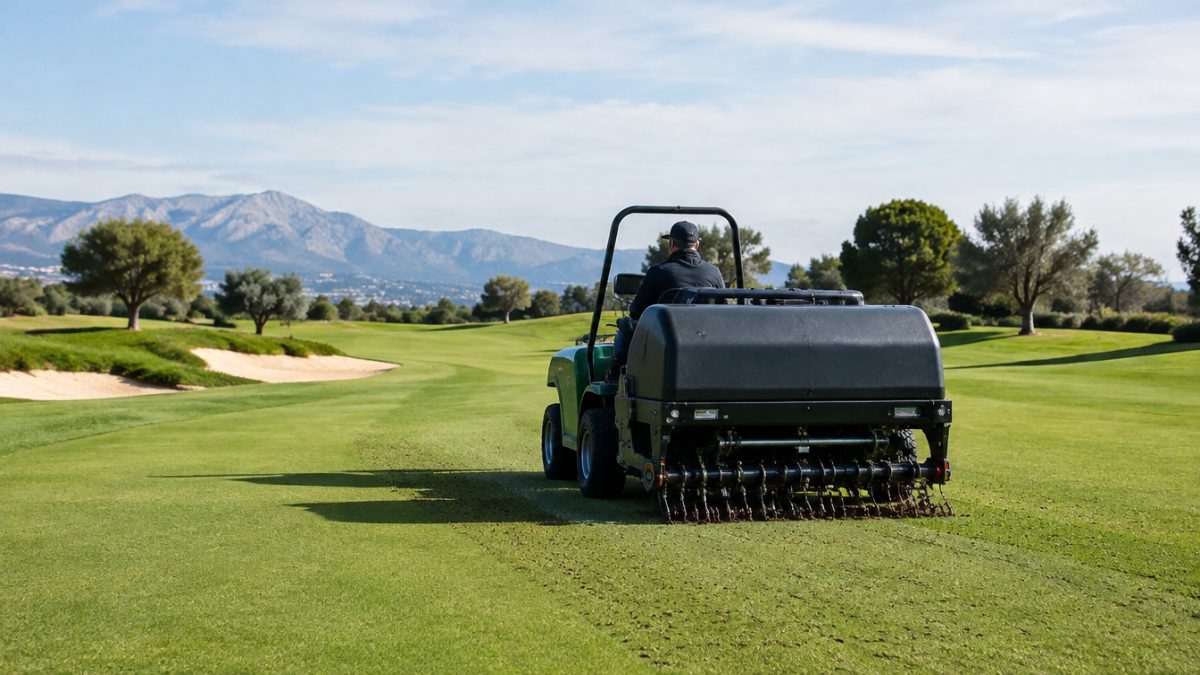
Aerate, scarify and control thatch on golf fairways
Buggy traffic, passing machinery and play itself compact the soil over the years. Compacted soil infiltrates worse, holds less air and develops shallow roots. That is why golf fairways benefit from a well-planned aeration routine, with the right tool for each moment.
It is worth combining different operations:
- Spiking or solid-tine aeration, to relieve compaction with little disruption to play.
- Core removal, when the profile needs renewing and organic matter reducing.
- Scarifying or verticutting, to control excess thatch in stoloniferous species.
- Light top-dressing, to level and improve the surface when the budget allows.
Schedule these operations for each species’ best recovery period and tell the club the dates in advance: a course that explains why there are aeration marks today receives far fewer complaints.
Control weeds, pests and diseases without losing control of the records
Healthy, dense golf fairways compete better against weeds, so the best prevention is everything above: suitable height, balanced nutrition and uniform irrigation. When intervention is needed, do it with an integrated management approach, identifying the problem properly before acting.
If a plant protection treatment is used, always follow the label, current regulations and the advice of an authorised technician, and keep a record of what was applied. Besides chemical control, cultural measures weigh heavily: removing excess surface moisture, improving ventilation and reducing turf stress.
Walking the golf fairways systematically, with a brief observation report, lets you detect patches, caterpillars, fungi or low-vigour areas in time. The earlier it is detected, the less area has to be treated and the fewer resources are spent.
Record tasks, hours and zones to know what they really cost
Maintaining golf fairways accounts for an enormous share of the course’s labour hours and fuel, and without data it is hard to know whether the effort is well distributed. Recording what is done, where and how long it takes lets you compare holes, detect problem areas and justify decisions to management.
A good record sheet includes:
- The task carried out (mowing, fertilising, hand watering, aeration, treatment).
- The hole or zone where it was done.
- The staff and machine hours used.
- Observations on the condition of the turf.
With a few months of data you can answer very specific questions: which fairway uses the most hours, which needs the most hand watering or where it makes sense to invest in drainage. That information turns maintenance into a process that improves, instead of being repeated out of habit.
Further reading: USGA. The USGA gathers reference technical resources on turf management that can serve as a benchmark for adjusting your own practices.
Frequently asked questions
How often should golf fairways be mown?
It depends on the species, the time of year and the level of service. In the full growing season they are usually mown several times a week, and less often when the turf grows less. The essential thing is not to remove too much leaf at once and to keep the blades sharp for a clean, uniform cut.
What is the main mistake when fertilising golf fairways?
Applying too much nitrogen without an analytical basis. That drives growth, mowing and thatch, and increases susceptibility to disease. It is better to start from soil analysis, spread the inputs across each species' active season and deduct the nutrients that already arrive with the irrigation water.
When is it best to aerate golf fairways?
At the time of the species' best recovery: spring and summer for warm-season grasses, and autumn or spring for cool-season ones. Avoid stress periods and warn the club in advance. Combining spiking, coring and scarifying according to the condition of the profile usually gives better results.
Keep reading
- how to choose the turf cutting height Mowing height: a complete guide by course zone
- thatch control on greens and other surfaces Thatch in greens: 6 warning signs and how to reduce it
- reel sharpening for a clean cut Reel sharpening: 6 steps for a clean cut