

When more green speed is wanted, the immediate temptation is to lower the mowing height. But that decision has a cost for the plant, especially in summer or on stressed turf. That is why rolling greens is one of the operations most valued by maintenance crews: it smooths the surface, improves the roll and eases the pressure on the turf.
It is not a miracle operation and it is not for every situation. In this article we look at five benefits of rolling, when it makes sense, which risks to watch and how to record it so you know what really works on your course.
What rolling greens is and the effect it produces
It involves running a roller, normally self-propelled and of controlled weight, over the surface of the green. The aim is to smooth out small irregularities, settle the canopy and reduce friction between the ball and the turf, without cutting or removing any plant material.
The effect is physical: the leaves are slightly flattened and the surface is made uniform. That is why the improvement in speed and smoothness is usually noticeable the same day, although it lasts less than that from other operations such as top-dressing or mowing. Rolling greens works better as a complement to a good management programme than as a substitute for mowing, irrigation or fertilisation.
Benefit 1: more speed without lowering the mowing height
The first benefit is the most sought after. A pass of the roller can noticeably increase green speed without having to lower the mowing height any further. That reduces plant stress and keeps the turf’s energy reserves up in delicate periods.
A common example: on a vigorously growing bermudagrass green, the crew prefers to keep the mowing height and add rolling in the days before a competition, rather than lowering the cut and risking the turf. It is a management decision, not a fashion.
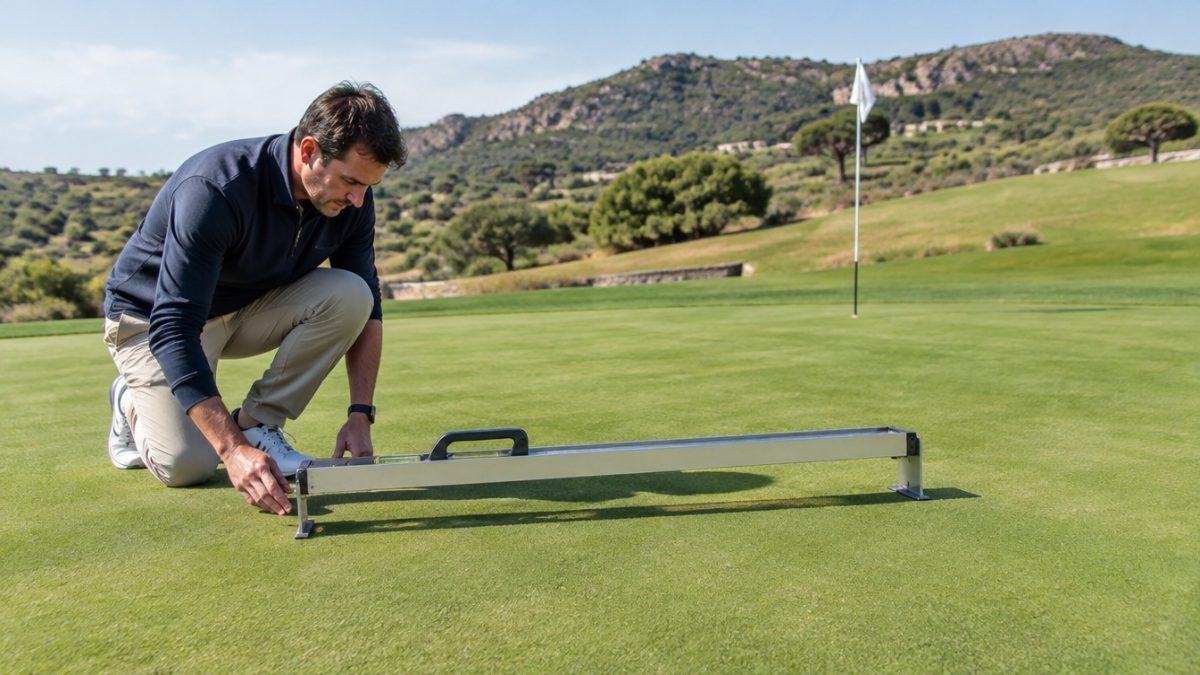
The improvement depends on the species, density, moisture and weight of the roller. If you need to confirm it, measure with a Stimpmeter before and after, always with the same procedure and in similar conditions. With your own data you will know how much rolling greens really adds on your course and when it is worth doing.
Benefits 2 and 3: consistency and smoothness of roll
The second benefit is consistency. After mowing, small differences in height and leaf orientation can upset the roll. The roller smooths out these irregularities and leaves a more uniform surface between areas and between days.
The third is smoothness: the green looks cleaner, the ball rolls more continuously and the feeling of a grainy or marked surface is reduced. This is especially useful after tining, top-dressing or operations that leave the surface somewhat disturbed. It also helps on heavily trafficked greens, where daily wear leaves small footprints that the player notices.
- Useful after aeration or top-dressing to settle the surface.
- Helps smooth light marks and footprints.
- Helps even out the roll before events.
Benefits 4 and 5: less plant stress and more operational flexibility
The fourth benefit is relief for the turf. Replacing a mowing with a rolling, when the programme and growth allow, reduces cutting and wear on the plant. In hot weather or with weakened turf, that difference helps maintain the health of the green.
The fifth is flexibility. A crew that has mastered rolling greens can tune tournament preparation better, alternating mowing and rolling depending on the day, the moisture and the playing calendar. This avoids the all-or-nothing effect of lowering or raising the mowing height weeks before an event.
That said, any substitution must be based on observation and data, not just intuition. It pays to note what was done on each green and what result was obtained. Over time, those notes show which greens respond better to the roller and which need a different approach, because of their orientation, shade or profile.

Limits and precautions: compaction, moisture and frequency
The main risk of rolling greens is compaction if it is overdone or carried out when the soil is too wet. Excessive weight, repeated passes along the same line or rolling with a saturated profile can damage soil structure and limit root development.
Some useful precautions:
- Avoid rolling when the green is saturated or has just been over-irrigated.
- Vary the routes so as not to mark the same lines every time.
- Adjust frequency and weight to the species and the time of year.
- Complement with aeration to keep the profile healthy.
If in doubt, start with a moderate frequency, watch the turf’s response and the firmness of the soil, and adjust. Every course reacts differently, and there is no universal rule. Train the operator too: rolling greens takes a steady hand, attention to turns and care at the edges, where a bad turn marks the turf.
How to plan and record weekly rolling
To know whether it works, you need to record it. Note the date, time, greens treated, type of roller, operator, moisture conditions and later observations. If you also measure speed and firmness, you will get a complete picture of each operation.
A simple system for organising rolling greens:
- Define a base frequency according to the season and playing pressure.
- Reserve rolling for the days and times when the green is in suitable condition.
- Coordinate the order of operations: mowing, rolling and, where relevant, other tasks.
- Review the data each month and adjust the plan.
And do not forget maintenance of the roller itself: axles, bearings, a clean surface free of dents. With that history you can explain to the committee why rolling greens is part of your programme, what improvements it brings and how much work it involves.
Further reading: USGA. To learn more about green speed and how it is measured, you can consult the USGA resources.
Frequently asked questions
How often should greens be rolled?
As a rough guide, between once and several times a week depending on the species, season, playing pressure and soil condition. The important thing is to start with moderate frequencies, watch the turf's response and adjust. Avoid rolling when the profile is saturated and combine the operation with aeration to keep the soil healthy.
Does rolling greens replace mowing?
It does not replace it, but at certain times it can reduce the number of mowings without losing surface quality. It is a complement that smooths and settles the canopy. The decision should be based on speed, growth and green condition data, and not as a fixed rule for the whole year or for all greens alike.
Can rolling greens compact the soil?
Yes, if it is overdone, done with too much weight or when the soil is very wet. To reduce the risk, vary the routes, adjust the frequency, avoid saturated days and keep up an aeration programme. Measure firmness and watch rooting to detect any sign of compaction in time.
Keep reading
- Stimpmeter: measuring green speed Stimpmeter: 5 Steps to Measure Green Speed
- Soil compaction: causes and solutions Soil Compaction: 5 Causes and Fixes on Golf Courses
- Green firmness: how to measure and improve it Green Firmness: 5 Ways to Measure and Improve It