
With less play, less light and turf that barely grows, January invites you to slow down. That is a mistake: the greenkeeper tasks in January are the ones that prepare for spring and avoid surprises when the course fills with players again. The key is to use the window to do what does not fit into peak season.
We have put together seven jobs that tend to work on Mediterranean-climate courses. It is not a closed list: your area, your species and your tournament calendar will set the order. Use it as a starting point for your own roadmap.
Watch the condition of dormant turf and frost
In January, bermudagrass and kikuyu are usually in vegetative dormancy and ryegrass or Poa annua grow slowly. The first of the greenkeeper tasks in January is to observe: are there areas with poor drainage? Are disease spots appearing? Where does frost linger in the morning?
Avoid traffic on frozen turf and communicate the restriction to reception and the starter, because the leaves break and the marks take weeks to recover. If your course gets frosts, consider delaying the start of play or limiting buggies while the frost lasts. Those decisions are better made with a checking routine than with improvisation.
Adjust mowing and cutting height to the season
Among the greenkeeper tasks in January, mowing changes pace: with slow growth, frequencies drop and cutting heights are usually raised slightly, especially on greens, to protect the plant from stress. As a rough guide, it is a good time to review blade sharpening and reel adjustment, because mowing with a dull tool tears the leaf and opens the door to disease.
- Review the mowing schedule by area and reduce frequencies where they are not needed.
- Avoid mowing frozen or very wet leaves.
- Check cut quality on greens after each pass, not just speed.
Maintain drainage and clear standing water
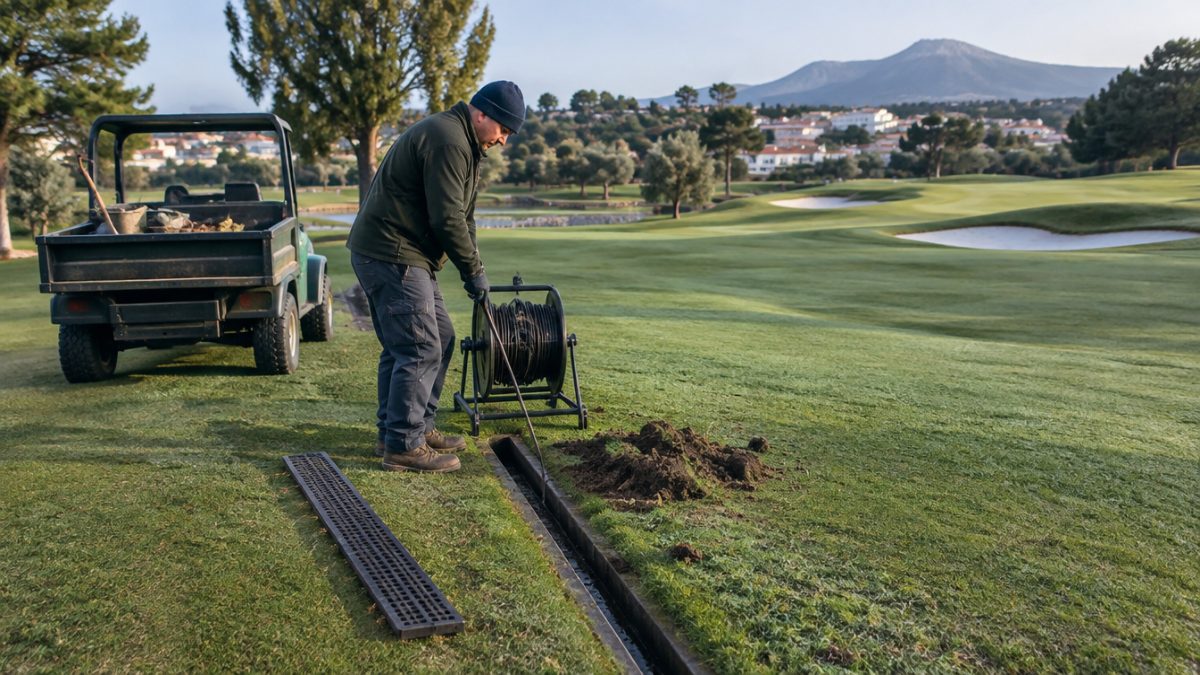
Winter rains put the course to the test. Another of the greenkeeper tasks in January is drainage. Check channels, sumps, outlets and manholes, and clear leaves, mud and sediment before they clog. On greens, light spiking or surface aeration on suitable days helps keep the upper layer permeable.
Note the spots that get waterlogged and look at them again after each heavy rain. Among the greenkeeper tasks in January, this is one of the best returns, because poor drainage feeds disease, compacts the soil and forces you to close areas.
Check the irrigation system while it is not needed
Irrigation is resting, and among the greenkeeper tasks in January that makes it the ideal moment to check it. Test sprinklers, nozzles, valves, controllers and pumping stations. Walk through the sectors with the system running for a few minutes, to find leaks, tilted sprinklers, badly adjusted arcs or buried heads.
If you have not done so before peak season, it is worth planning a small uniformity audit. A repair in winter costs less, is less urgent and does not compete with the turf’s water demand. It also lets you check whether the sector map and pressures are still those shown on the course plans.
Give priority to the workshop: machinery maintenance
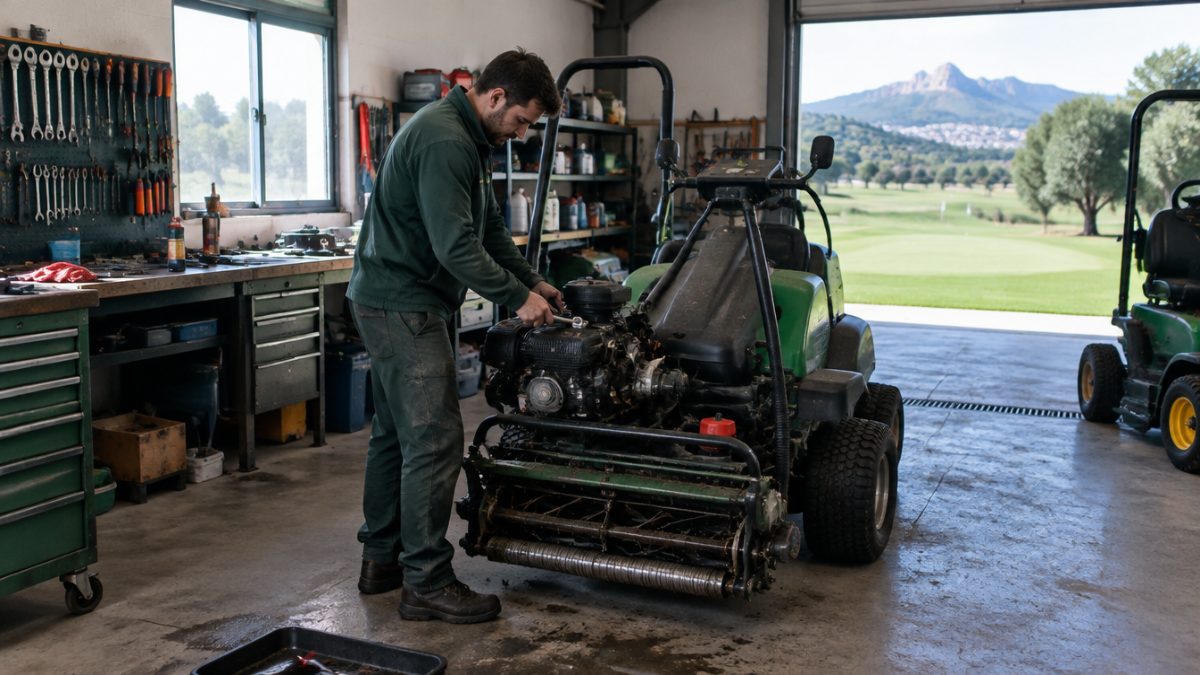
Among the greenkeeper tasks in January, the workshop rules: it is machinery maintenance month. Schedule preventive maintenance for all machines: oil and filter changes, greasing, checking belts and hoses, testing batteries, sharpening and adjusting reels and blades, and checking tyres. Doing it now stops a breakdown catching you in mid-season.
Prepare a list of critical spare parts and order those with long lead times. Record the hours of use of each unit and the work done, because that data will help plan replacements and justify budgets.
Take the chance to prune, clean and improve out-of-play areas
With fewer players, it is easier to take on greenkeeper tasks in January that in summer would disturb play, such as working in heavily trafficked areas. It is a good time for pruning trees and hedges while the plant is dormant, bunker maintenance, path repairs, cleaning lakes and streams or fixing fairway and tee box edges. In the case of pines, watch for processionary nests before sending anyone to work under them.
Plan these jobs by area and avoid piling them all into the same week. A good rule is to tell reception in advance which holes will have works or restrictions, so there are no surprises.
Close out the greenkeeper tasks in January by planning the season and training the team
The last of the greenkeeper tasks in January is the least visible and the most rewarding: sitting down to plan. Review the budget, the tournament calendar and spring jobs such as aeration, top-dressing, fertilisation or overseeding, and spread the workload so it does not concentrate in a few weeks.
Use the time to train staff too. A refresher on safety, machinery operation, products and work protocols takes few hours and gives a lot back. End the month with a short meeting where each manager explains what has been done and what is outstanding, and put the plan for the coming weeks in writing.
Further reading: AEMET. To follow frost and rainfall forecasts for your area, consult Spain's State Meteorological Agency (AEMET).
Frequently asked questions
What are the most important greenkeeper tasks in January?
The most rewarding are usually preventive machinery maintenance, the irrigation check, drainage cleaning and spring planning. All of them use the low activity to anticipate problems. The rest depends on the climate of your area and the species you maintain.
Should you fertilise in January?
It depends on the species, the climate and the needs shown by the soil analysis. In general, with turf dormant or growing very slowly, inputs are small and cautious. Any fertiliser or plant protection product must be applied according to the label, current regulations and the advice of an authorised technician.
How do you organise the greenkeeper tasks in January with a small team?
It pays to prioritise by impact and urgency: first what affects safety and playing quality, then what prevents breakdowns in season, and lastly improvements. A weekly schedule with owners and dates helps avoid scattering effort and shows what is still to be done.
Keep reading
- How to prepare a golf course for peak season How to prepare a golf course for peak season
- Replacing the machinery fleet: key decision factors Replacing the machinery fleet: 6 key decision factors
- Fusarium patch in turf: winter measures Fusarium patch in turf: 5 winter measures