

A dark green, almost velvety patch that spreads across a green and does not mow well: moss on greens is one of the most annoying problems of winter and of damp areas. It alters the playing surface, affects the roll of the ball and, if not corrected, ends up taking the place of the turf.
The important thing is to understand that moss does not kill the turf: it occupies the space the turf leaves free. We review five common causes, how to diagnose them and which cultural measures help prevent it, without resorting to quick fixes that do not tackle the source.
What Moss on Greens Is and Why It Appears
Moss is a primitive plant without true roots that colonises surfaces where the turf fails to close the cover. On greens it usually appears as small, dense colonies, dark green or with silvery tones when dry, that merge into patches.
Its appearance is a consequence, not a cause. If there is moss, it is because something has put the turf at a disadvantage: little light, excess moisture, compacted soil, cutting too low or insufficient fertility. That is why one-off treatments without correcting the environment fail: the patch disappears for a few weeks and returns as soon as conditions favour moss again.
Cause 1: Little Light and Poor Air Circulation
A green surrounded by trees that shade it in the morning or in the months of lowest sunlight dries slowly, receives less radiation and competes worse. In winter the effect is multiplied because the sun is lower.
- Check which branches or trees cast shade on the green throughout the day.
- Consider thinning pruning or removal of trees that limit ventilation.
- Check there are no hedges, nets or barriers slowing the air.
When moss on greens recurs in the same quadrant, it usually reveals a light or air problem. Solving that often gives better results than any later treatment, even though it requires delicate decisions about trees and agreement with the green committee.
Cause 2: Excess Surface Moisture
Moss thrives where the surface stays wet for many hours. The causes can lie in water management itself:
- Frequent, shallow irrigation that keeps the top layer saturated.
- Dew or night-time moisture that is not removed due to lack of air movement or early-morning mowing.
- Areas with poor surface drainage where water stagnates.
- Irrigation with overlaps or leaks that add too much water at specific points.
It pays to check irrigation uniformity and adjust run times to irrigate less often and more deeply when the turf allows. Careful control of soil moisture, with a probe or periodic measurements, is one of the most cost-effective measures against moss on greens.
Cause 3: Compaction and Poor Drainage
A compacted profile breathes poorly, drains slowly and has shallow roots. The turf weakens and moss on greens takes the opportunity. It is common in high-traffic areas, such as green approaches and exits, and on old greens with excess fines or organic matter.
The usual operations to restore porosity are:
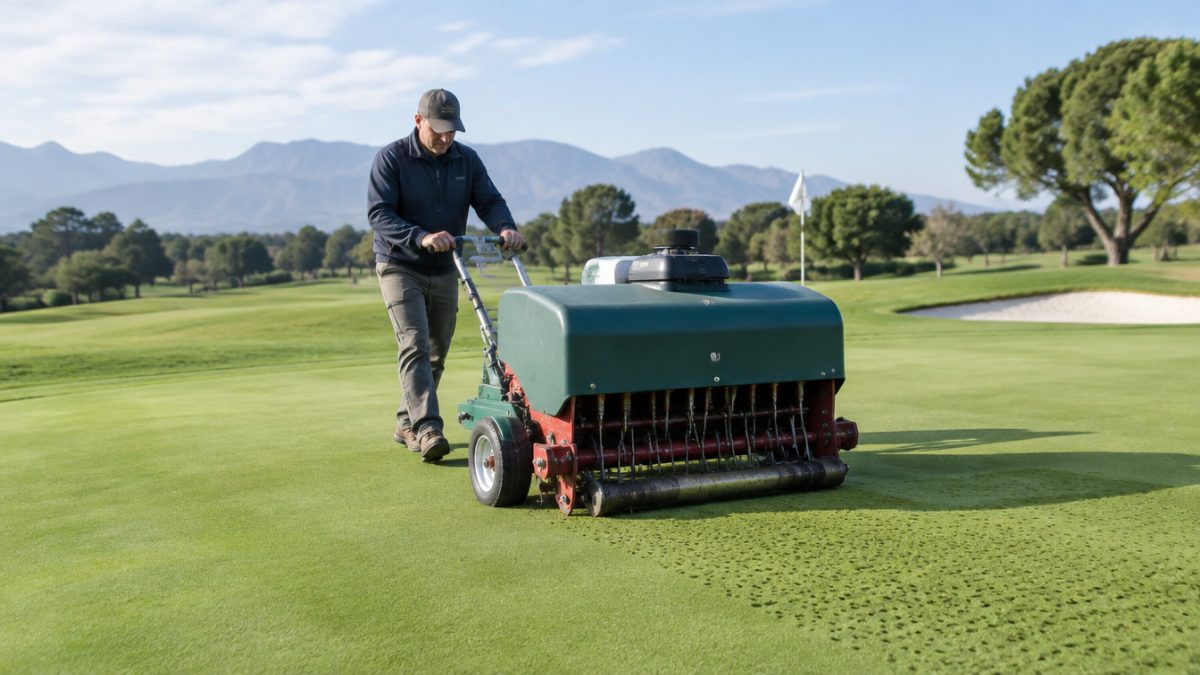
- Aeration with solid or hollow tines, depending on the season and the tolerance of play.
- Top-dressing with sand compatible with the profile, to dilute organic matter.
- Deep tining at a frequency adapted to the condition of the soil.
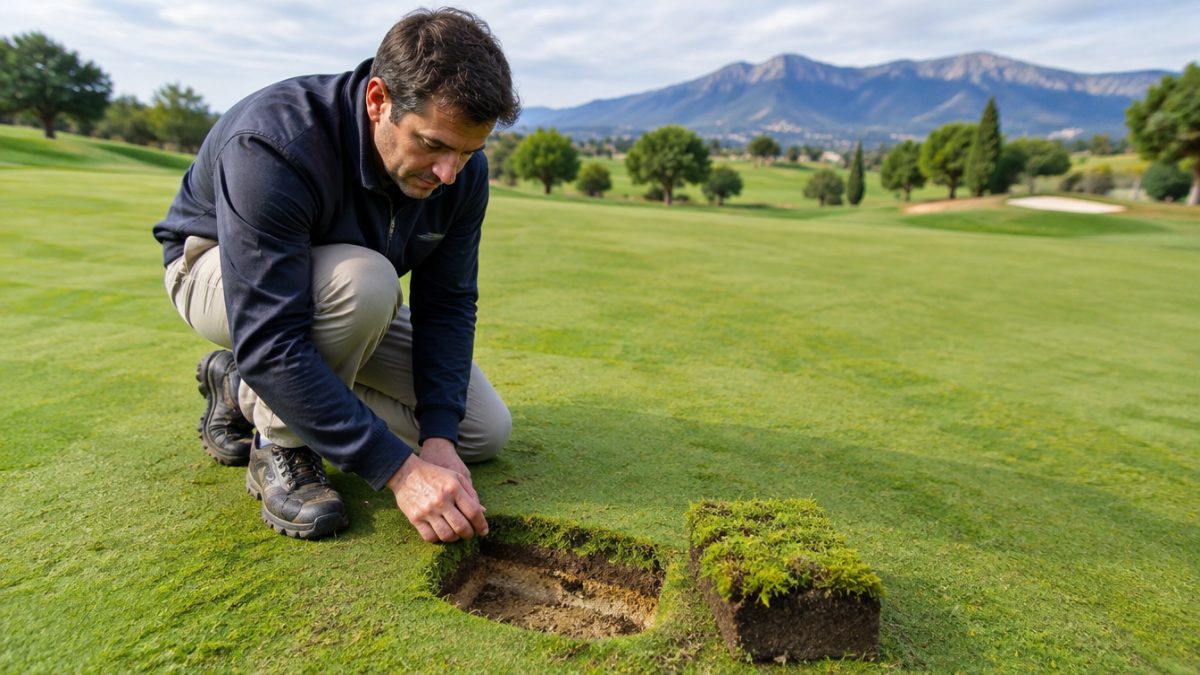
Before deciding, it pays to check with a trial pit whether there are layers that slow down water. Sometimes the problem is not at the surface, but a few centimetres below.
Cause 4: Weak Turf Due to Cutting Height and Fertility
Turf mown too low, continuously, loses density and recovery capacity. If nutrition is also insufficient, growth slows and gaps open up. Two typical winter mistakes are lowering the height unnecessarily and cutting out fertilisation entirely for fear of disease.
- Raise the cutting height slightly in periods of lower growth.
- Adjust the fertilisation plan to the species and the season, with a balanced input.
- Avoid mechanical stress: less aggressive verticutting when the turf is not recovering.
Healthy, dense turf closes the door on moss on greens. On many courses, simply recovering density visibly reduces the colonies within one or two seasons.
Cause 5: Unfavourable Organic Matter and pH
Thatch build-up retains water and hinders drainage of the top layer, creating a very favourable environment for moss on greens. It should be controlled with aeration, regular top-dressing and moderate scarifying, always adapted to the season and the species.
Soil pH and fertility status also have an influence. A periodic soil analysis helps decide whether corrections are needed, and avoids taking measures blindly. If you consider any product to control moss on greens, remember that these are plant protection products or regulated treatments: you must follow the label, current regulations and the advice of an authorised technician, and never use them as a substitute for correcting the causes.
Prevention Plan: Observe, Correct and Record
An orderly approach to moss on greens combines observation and record keeping:
- Locate: mark the affected areas on a plan at each inspection.
- Diagnose: associate each area with a possible cause (shade, moisture, compaction).
- Correct: prioritise acting on the source, not the symptom.
- Record: note dates, operations and progress to assess what works.
If moss reappears on the same green and in the same season, the records will let you spot the pattern and get ahead of it. It is the difference between firefighting and managing moss on greens as what it is: an indicator of the green’s overall condition.
Further reading: STRI Group. STRI Group, a leader in sports turf research, publishes technical guides on the management of playing surfaces and associated problems.
Frequently asked questions
Why does moss appear on greens in winter?
In winter there is less light, more moisture and slower turf growth, three conditions that favour moss on greens. If there is also compaction, thatch or a low cutting height, the turf leaves gaps that moss colonises. That is why it pays to strengthen aeration, drainage and density before the wet months arrive.
Can moss on greens be eliminated with products alone?
Rarely in a lasting way. A treatment can reduce colonies, but if you do not correct the cause, moss returns. Any plant protection product must be applied following the label, current regulations and the advice of an authorised technician. The sustainable approach is to combine cultural management, improved drainage and recovery of turf density.
How often should I check the greens for moss?
It pays to do a systematic visual check at least once a week in wet periods or periods of low growth, paying attention to shaded and slow-draining areas. Noting the location and progress of patches lets you spot patterns and act before colonies merge and occupy larger areas.
Keep reading
- Thatch on greens: how to control it Thatch in greens: 6 warning signs and how to reduce it
- Fusarium in turf: prevention and management Fusarium patch in turf: 5 winter measures
- Pesticide treatment records Pesticide Application Records: 6 Key Data Points