

Every greenkeeper knows the scene: the course looks uniform first thing and, by mid-morning, brown patches the size of a rug appear on a green or a fairway. Localized dry spots test the team’s patience, because the usual reflex, giving more water, often makes the picture worse instead of solving it.
In this article we review six management solutions ordered from the simplest to the most structural: how to confirm the problem is really about moisture, how to check the irrigation system, what to do about water-repellent soil, how to relieve compaction and how to document each case so it is not repeated.
Confirm the cause of localized dry spots before acting
Not everything that looks dry is short of water. Among localized dry spots, a brown patch may be due to real drought stress, but also to root disease, grub damage, spilled fuel or fertiliser, or a shallow root system that does not reach the available moisture. Treating the symptom without a diagnosis is the most expensive way to manage turf.
A short protocol helps a lot:
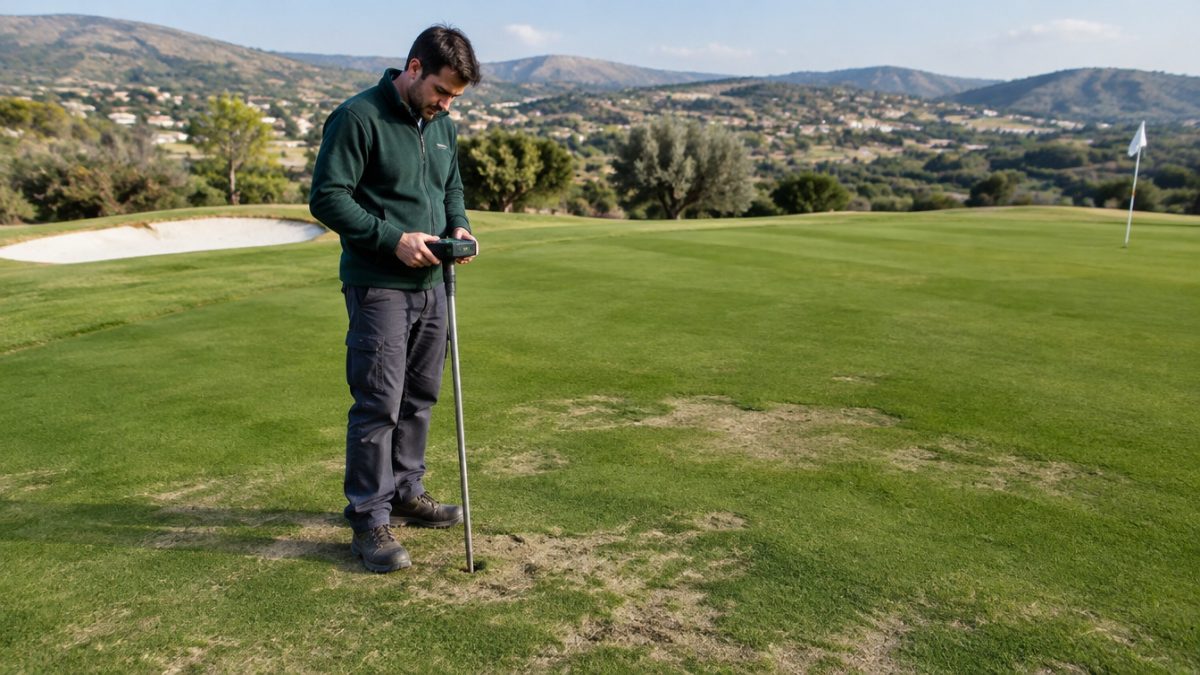
- Push in a soil probe or a core sampler and observe moisture at different depths.
- Check rooting depth: if it is only a few centimetres, the problem is one of rooting, not just irrigation.
- Gently pull on the turf: if it lifts like a carpet, suspect grubs or damaged roots.
- Photograph the patch and note the time, aspect and condition of the surroundings.
With that information, the decision stops being a hunch and becomes a criterion shared by the whole team.
Check the irrigation system where the dry spots appear
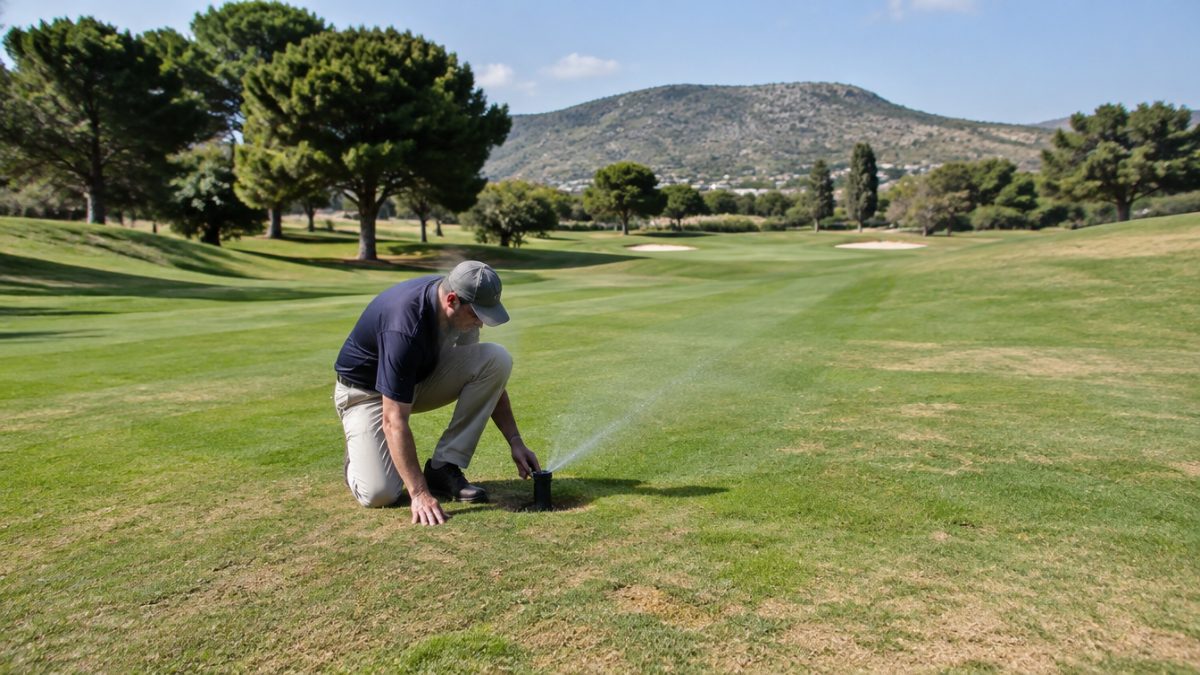
When localized dry spots keep recurring in the same place, irrigation is the first suspect. A clogged nozzle, a tilted sprinkler, a poorly adjusted arc or insufficient overlap leave areas that receive much less water than their surroundings, and the turf shows it within days.
It is worth doing an inspection round with the system running:
- Check that each sprinkler completes its full rotation and does not stick.
- Verify that no grass, sand or soil is covering the head.
- Check that the spray is not deflected by wind or by trees that have grown.
- Detect abnormal line pressures: a localized drop usually indicates a leak upstream.
A uniformity test with cups or cans, however simple, confirms whether the application pattern explains the patch. If the water arrives well and the spot stays dry, the problem is in the soil.
Treat the hydrophobic soil that causes localized dry spots
Hydrophobicity often appears in green rootzone sands and in soils with a lot of dry organic matter: the particles become coated with organic compounds and water runs off instead of infiltrating. The classic symptom is a hard, dry patch on the surface while, a few centimetres lower, the profile is damp or soaked in other areas.
A quick test is to drop a few drops of water onto bare soil and see how long they take to soak in. If they stay on the surface for several seconds, there is repellency. Management usually combines several measures:
- Schedule wetting-in irrigation in short cycles, with pauses, so the water penetrates without running off.
- Use wetting agents as part of a preventive programme, always following the label, current regulations and the advice of an authorised technician.
- Aerate with fine tines to open pathways into the profile.
- Avoid accumulating excess organic matter at the surface.
Relieve the compaction that concentrates dry spots
High-traffic areas, such as green approaches, tee exits or machine tracks, tend to become compacted. Compacted soil absorbs water poorly, holds short roots and heats up faster. The result is localized dry spots that reappear every summer even when you irrigate generously.
The solutions involve restoring porosity to the profile: aeration with solid or hollow tines, deep spiking in critical areas and, where appropriate, sand top-dressing to keep the channels open. It is worth combining this with traffic management measures:
- Rotate the entries and exits of greens and the buggy crossings.
- Avoid machines always turning at the same point.
- Rope off areas under recovery.
Aeration works best with the soil at the right moisture, neither soaked nor bone dry, so plan it by looking at the forecast and the playing schedule.
Irrigate by zone and support with targeted hand watering
Even with the system adjusted, localized dry spots persist because the course’s microclimates make some areas dry out sooner than others: south-facing slopes, green edges, shallow soils over rock or boundaries with trees that compete for water. Keeping the same run time across an entire sector is an invitation to have some zones waterlogged and others stressed.
A practical strategy is to irrigate in general according to water demand and complete it with targeted interventions:
- Hoses or hand watering first thing in the morning at known spots.
- Split cycles on slopes to avoid runoff.
- Adjusting stations to separate areas that always ask for more water.
- Checking moisture with a probe before each supplementary watering.
Against localized dry spots the aim is not to wet more, but to wet where it is needed and at the right time, and in the medium term to reassign stations to reduce manual work.
Document each case and learn from localized dry spots
The best tool against localized dry spots is the course’s memory. If every time a patch appears someone fixes it and nobody writes it down, the problem will return next season and the cause will have to be rediscovered from scratch.
Keep a simple record that includes, at least:
- Exact location and date of detection.
- Diagnosed cause and evidence, such as photos and moisture readings.
- Corrective action taken and who carried it out.
- Result at seven and thirty days.
With just a few months of data on localized dry spots, patterns appear: a sector that always fails, a repeat-offender sprinkler or an area that requires the profile to be renewed. That information sets investment priorities and lets you explain to the committee why a specific project is proposed, with facts and not impressions.
Further reading: USGA. To go deeper into water and soil management on greens, the USGA brings together reference technical resources.
Frequently asked questions
Why do localized dry spots keep reappearing in the same place?
Because the cause is usually structural: a misaligned sprinkler, compacted soil, a hydrophobic layer or very shallow roots. If you only add more water, the symptom improves for a few days and returns. It is best to diagnose with a probe, a uniformity test and a look at the profile, and to correct the source instead of repeating the patch.
Does increasing irrigation fix localized dry spots?
Almost never in a lasting way. If the soil repels water or is compacted, the excess is lost as runoff and worsens other areas. First check how much water arrives and how much infiltrates. Then adjust the application, split it into short cycles and work on the soil with aeration or wetting agents under technical advice.
When should I call a technician about dry spots?
When the pattern does not fit an obvious irrigation or soil cause, when the patches spread quickly or when signs of disease or pests appear. Also before any fungicide or wetting agent treatment, which must follow the label, current regulations and the judgement of an authorised adviser.
Keep reading
- the importance of efficient irrigation in course care The importance of efficient irrigation in golf course care
- rules for using wetting agents well Wetting Agents: 5 Rules for Using Them Well
- five tests to measure irrigation uniformity Irrigation Uniformity: 5 Tests to Measure It in the Field