

On golf courses in the southern half of Spain and along the Mediterranean coast, bermudagrass is one of the most widely used species on fairways, tee boxes and, in many cases, greens too. It loves the sun, withstands heat well and recovers quickly, but its aggressive nature and winter dormancy require a methodical approach.
This article collects six management keys designed for the Spanish climate: how to mow, how to feed, how much to irrigate, how to control thatch, how to watch the edges and how to manage the transition into winter. They are guideline criteria that each course must adjust to its variety, soil and water.
Key 1: mow bermudagrass low and often
Bermudagrass is a species that spreads laterally by stolons and rhizomes and responds very well to low, frequent mowing. A cutting height that is too generous encourages grain, the build-up of dead material and a spongy surface that penalises play.
Some ideas for the mowing programme:
- Adjust the height according to the zone and the variety: fine hybrids tolerate very low heights, common types will need a little more.
- Change the mowing direction regularly to reduce grain.
- Keep blades sharp: a torn cut leaves whitish tips and makes disease easier.
- Avoid removing more than a third of the leaf at one time.
In midsummer, when bermudagrass grows at great speed, it may be necessary to mow daily on heavily used fairways and tee boxes to maintain quality.
Key 2: feed bermudagrass according to its growth rate
Bermudagrass nutrient demand follows temperature. In cold soil it consumes almost nothing; in sustained heat its appetite for nitrogen is considerable. A sensible fertiliser plan concentrates inputs in the active growing period and reduces them in late autumn.
As a general rule:
- Split nitrogen into moderate applications instead of a few heavy ones.
- Base the programme on soil tests and, if possible, tissue tests.
- Do not forget potassium, closely linked to tolerance of stress and wear.
- Avoid fertilising heavily just before winter dormancy.
Fertilisation should be designed with a competent technician or adviser and in line with current regulations, particularly in nitrate-vulnerable zones or those with specific restrictions.
Key 3: irrigate bermudagrass deeply and infrequently
Although bermudagrass withstands drought well, correct irrigation management makes the difference between turf that survives and turf that performs. The aim is to encourage deep roots, for which it is best to irrigate less often but with enough depth of water to moisten the profile.
Some points to watch on coastal and inland courses:
- Adjust irrigation to evapotranspiration and not to a fixed calendar.
- Check water quality, especially if it is recycled or brackish, since bermudagrass tolerates some salinity but is not immune.
- Avoid irrigating during the windiest and hottest hours.
Bermudagrass on Spanish courses withstands harsh summers better than other species, but excess water in autumn or spring favours disease and more thatch. Irrigating with judgement saves water and improves playing quality.
Key 4: control thatch with scarifying and top-dressing
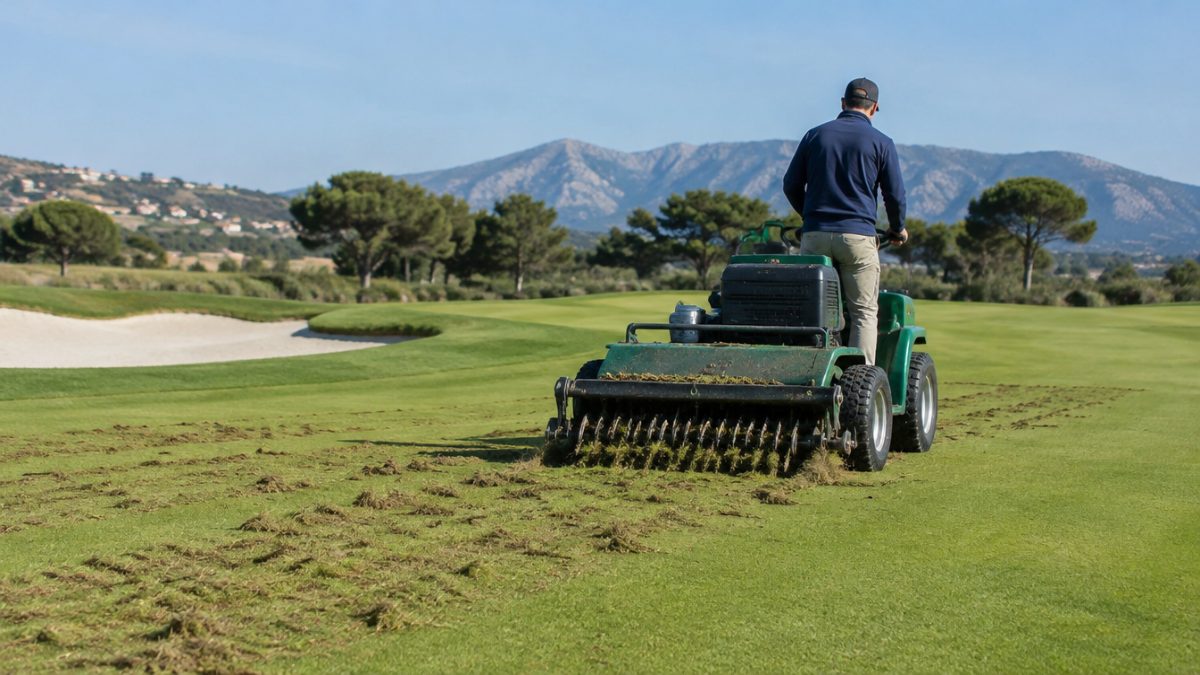
Bermudagrass vigour comes at a price: it builds up organic material at the base easily. If it is not removed, thatch retains moisture, hinders infiltration, hides pests and makes the surface soft and prone to scalping.
The control programme usually combines:
- Light, frequent verticutting or scarifying during active growth.
- Deeper scarifying in the periods of greatest vigour, with quick recovery.
- Aeration and sanding to dilute the organic matter.
- Balanced fertilisation and irrigation so as not to generate more material than is removed.
It is best to schedule intensive operations when bermudagrass can recover within a few weeks, that is, in high temperatures, avoiding doing them on the eve of cold weather.

Key 5: watch the edges and transition zones
The aggressiveness of bermudagrass is an advantage on the playing surface and a problem on the margins. Its stolons invade flower beds, paths, bunkers and areas of other species if nobody stops them. A well-kept course draws clear boundaries and maintains them.
To control the edges of the surface:
- Define containment strips with a mechanical edge, trench cuts or barriers.
- Regularly cut back stolons that cross towards bunkers and shrubs.
- Pay attention to the transition points with ryegrass or kikuyu, where competition is intense.
On courses with winter overseeding, the spring transition requires care: reducing the ryegrass without damaging the bermudagrass waking up takes precise management of height, nitrogen and irrigation, and patience.
Key 6: manage bermudagrass winter dormancy
With low temperatures bermudagrass stops growing and takes on a straw colour. In areas with mild winters the dormancy is short; inland it can last for months. Each course must decide whether to accept that appearance or to overseed to maintain colour.
If you choose to leave bermudagrass dormant, take care of the following:
- Gradually reduce nitrogen and irrigation in late autumn.
- Limit buggy and foot traffic on dormant turf, which does not recover.
- Maintain the appropriate cutting height to protect the buds.
If you choose to overseed, plan the sowing while the soil is still warm, use quality seed and remove the ryegrass in good time in spring. In any case, a record of dates and results year after year lets you fine-tune the bermudagrass calendar for your microclimate.
Further reading: STRI Group. For studies and guides on sports turf species, the STRI Group is an international reference.
Frequently asked questions
What is the best cutting height for bermudagrass?
It depends on the variety and the playing area. Fine hybrid bermudagrasses withstand very low heights on greens and tee boxes, while common types, on fairways or rough, call for greater heights. What matters is to mow frequently, with sharp blades, and not to remove more than a third of the leaf at once.
Why does bermudagrass turn brown in winter?
It is a natural response to low temperatures: the plant enters vegetative dormancy, stops growing and loses the chlorophyll in the above-ground part. It does not mean it is dead. When temperatures rise it regrows from stolons and rhizomes, provided the winter has not caused damage through traffic or severe frost.
Can bermudagrass be combined with ryegrass in winter?
Yes, this is the usual practice of overseeding: ryegrass is sown over the bermudagrass in autumn to maintain colour and playability in winter. It requires good ground preparation and a careful spring transition, removing the ryegrass gradually so that the bermudagrass regains the lead without being weakened.
Keep reading
- complete guide to turf maintenance on golf courses Complete guide to turf maintenance on golf courses
- cutting height by course zone Mowing height: a complete guide by course zone
- tips for controlling kikuyu invasion Kikuyu on Golf Courses: 5 Tricks to Control Its Invasion