
When the committee asks why maintenance costs what it costs, the answer is usually a global figure and a glance at the floor. Task cost control lets you answer precisely: how much is invested in each task, in each zone and in each season, and what would happen if the frequency or method were changed.
You do not need sophisticated accounting to start. Below you will find five practical steps: defining the tasks, recording hours, allocating machinery and materials, analysing the results and turning them into decisions. All of it is designed for teams with little time for paperwork and a great need for clarity.
Step 1: define the tasks you are going to measure
Task cost control begins with a short, clear list of activities. If you define fifty tiny tasks, nobody will fill them in; if you define three generic ones, you will not get useful information. A good starting point is the tasks that account for the most hours and the most spending.
For example, you could group them like this:
- Mowing, by zone: greens, tee boxes, fairways, approaches and rough.
- Irrigation and system inspection.
- Aeration, scarifying and top-dressing.
- Fertilisation and applications.
- Bunkers, paths and signage.
- Machinery maintenance and workshop.
Use names that the whole team understands without explanations. Review the list after a few months of use: some categories will merge and others will need to be broken down. The important thing is to start with a simple structure that stays stable over time.
Step 2: record hours and people on each task
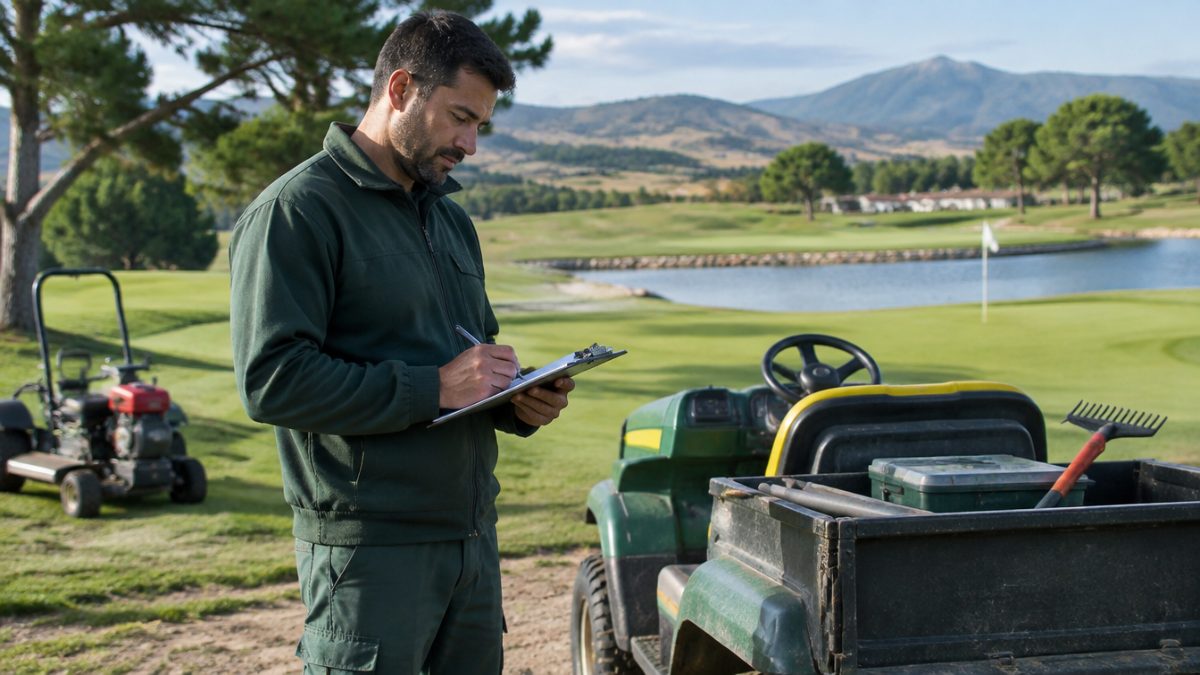
On a golf course, labour is usually the biggest item in the budget. That is why recording hours is the basis of any task cost control. It is about knowing who has spent how much time on each task and in which zone.
To make the record realistic:
- Do it at the end of each task, not at the end of the week, when it can no longer be remembered accurately.
- Accept reasonable approximations, for example in fifteen-minute blocks.
- Include overtime and temporary reinforcements.
- Explain to the team what it is for: it is not surveillance, but arguments for asking for resources.
When operators see that the data is used to argue for more staff or better machinery, the record stops being a burden and becomes a tool of their own.
Step 3: allocate machinery, materials and fuel
Labour is only one part. For complete task cost control it is worth also assigning the cost of machinery use, fuel, fertilisers, seed, sand and other consumables. Pinpoint precision is not needed: a reasonable, stable criterion is enough.
Some ideas for allocating without complication:
- Calculate an hourly cost for each machine based on depreciation, maintenance and consumption.
- Assign materials to the record of the task in which they are used.
- Spread shared costs, such as the workshop, with a simple, fixed rule.
With task cost control that combines hours, machine and materials, a real cost per task emerges. It is common to find surprises: tasks that seemed cheap turn out to be expensive, or old machines that cost more than a modern alternative.
Step 4: analyse task cost control through comparisons
Isolated numbers say little; compared, they tell a story. With a few months of data you can analyse trends and deviations. The most useful thing is to compare each task with itself over time and with the other zones of the course.
Look for questions like these:
- How much does it cost to mow a green compared with a fairway, per unit of area?
- In which months does spending on irrigation or repairs spike?
- What is the difference between doing a task in-house and subcontracting it?
- Which tasks consume hours without adding visible value for the player?
Analysing task cost control also helps detect recording errors, such as hours assigned to the wrong zone. Do not look for perfection: look for consistent patterns that let you decide with more information than intuition.

Step 5: turn the data into decisions and budgets
Measuring only makes sense if something changes. The last step is to use the information to make concrete decisions: reorganise mowing frequencies, plan shifts better, justify the purchase of a machine or adjust next year’s budget.
Three common uses:
- Budgeting by activity instead of by global line items.
- Defending an investment to the committee with data on hours saved.
- Prioritising what gets cut if spending has to be reduced, understanding the impact on quality.
Share the results with the team regularly. Task cost control that only management sees breeds distrust; shared and explained, it motivates people to look for improvements. And remember that the goal is not to spend less at any price, but to spend better and be able to show it.
Common mistakes when starting task cost control
Almost every course that tries it stumbles on the same stones. The first is wanting to measure everything from day one: categories pile up, the team tires of filling in work sheets and within a few weeks the system is abandoned. It is best to start modestly and build confidence.
Other frequent failures are:
- Changing the allocation criteria every month, which prevents comparing periods.
- Ignoring unforeseen tasks, such as repairs after a storm, which distort the averages if they are not identified separately.
- Not closing the loop: collecting data and never presenting it to anyone.
- Expecting task cost control to replace agronomic judgement, when it should only complement it.
A good system respects the reality of the course: in a month of rain or tournaments the numbers deviate, and that explained deviation is precisely the valuable information.
Further reading: GCSAA. The GCSAA offers resources on financial management and budget planning for course maintenance teams.
Frequently asked questions
Is it hard to introduce task cost control at a small club?
It does not have to be. A short list of tasks, a simple record of hours and a stable criterion for allocating machinery and materials are enough. Small clubs can start with the three or four tasks that consume the most and expand over time, as the team gets used to it.
What costs should task cost control include?
As a minimum, labour, machinery use and the materials used. If possible, add fuel, maintenance and subcontractors. The most important thing is to keep the same criterion from one month to the next, so that comparisons are consistent and the data is useful for making decisions.
How do I stop the team seeing the record as surveillance?
By explaining its purpose and sharing the results. When workers see that the data is used to ask for more resources, improve planning or recognise effort, they accept it better. Well-communicated task cost control is a tool for the team, not an instrument of individual monitoring.
Keep reading
- useful indicators for measuring course maintenance Course Maintenance KPIs: 8 Useful Indicators
- advantages of digital work orders on the course Digital Work Orders: 6 Advantages on the Course
- key metrics of a greenkeeper dashboard Greenkeeper Dashboard: 7 Key Metrics to Track