
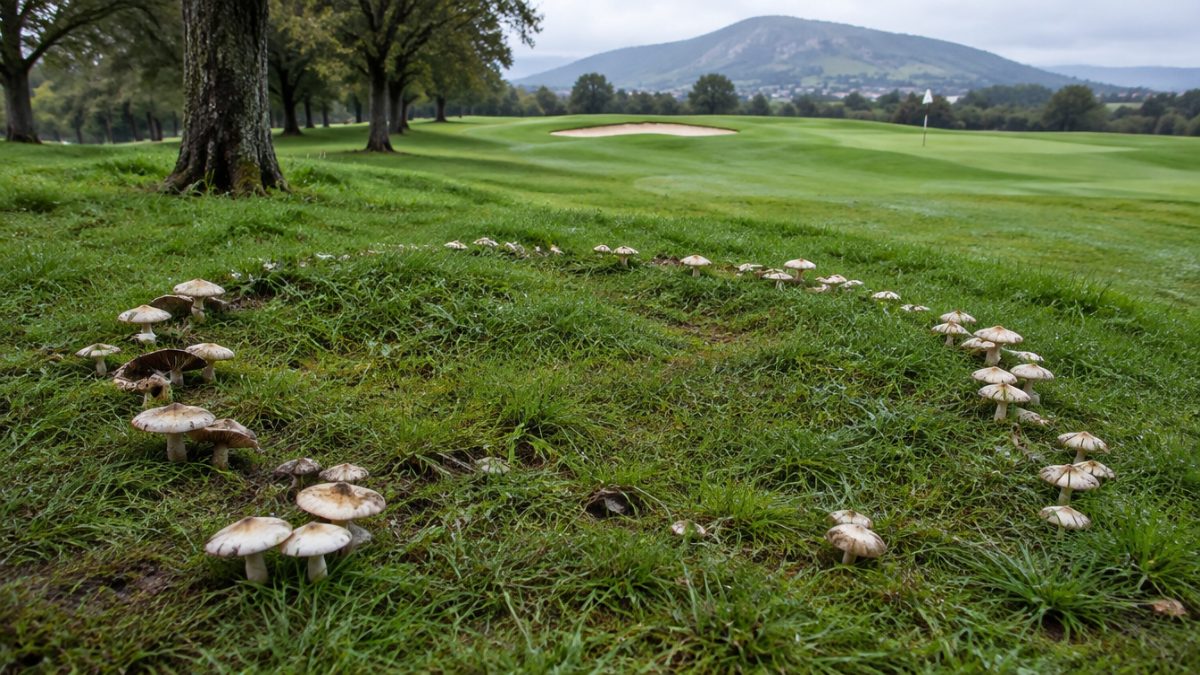
A ring of greener turf, a dry band that does not respond to irrigation or a row of mushrooms after rain: these are the typical signs of fairy rings. They appear on greens, tee boxes, fairways and rough, and are often mistaken for lack of water, a pest or a fertiliser problem, which leads to the wrong decisions.
Fairy rings are caused by soil fungi that grow in organic material and change the way water behaves in that band. In this article we explain how to identify them, what to do in each case and five realistic management solutions to reduce their effect, without promising a definitive cure that almost never exists.
How to Recognise Fairy Rings and Tell Them from Other Problems
There are several types, which differ in what happens to the turf. In some, a ring of darker, more vigorous turf appears with no appreciable damage. In others there is a dead or dry zone, because the soil becomes hydrophobic and does not let water through. In others, mushrooms simply sprout in the band after wet periods.
- Circular or semicircular shape, or arcs, growing a little larger each year.
- A band with soil that is dry to the touch even though the rest is moist.
- Whitish mycelium in the first few centimetres of soil, which can be seen with a small soil plug.
To tell them from drought, a sprinkler failure or a foliar disease, check the soil profile with a cup-cutter plug: if you see a dry, water-repellent layer or dense mycelium, fairy rings are very likely.
It is also worth noting the season and the species. In warm-season turf, such as bermudagrass, the symptom is usually more striking in summer; in cool-season turf, such as bentgrass or ryegrass, it may show with the first autumn rains. Noting when each ring appears helps you anticipate it in following seasons.
Solution 1: Improve Infiltration with Aeration and Spiking
The main damage from fairy rings is because water does not penetrate the affected zone. Opening channels so water reaches the soil is the first step. Spiking with fine tines, repeated aeration and light passes, without damaging the turf, help water reach the roots.
Do these operations on the affected band and a margin around it, because the fungus is often ahead of what can be seen. Combine them with light, repeated irrigation, better than one long watering that runs off without soaking in. Patience is key: the effect shows in weeks, not days.
A field example: on a tee box with a dry arc that returns every summer, the team schedules shallow spiking every few weeks during the critical period, along with short waterings first thing in the morning. It does not eliminate the fungus, but keeps the turf alive and playable, and reduces the time the area looks deteriorated.

Solution 2: Wetting Agents and Well-Distributed Irrigation
Wetting agents help water to rewet repellent soil. They are applied to affected areas, always following the label, current regulations and the advice of an authorised technician, and it is best to do so before the symptom becomes very obvious.
- Spot the dry band early, preferably with a probe or a simple screwdriver rather than by eye.
- Irrigate lightly and frequently, to wet the top layer without causing runoff.
- Avoid excess water on the rest of the green so as not to overcompensate.
Water management is, along with aeration, the most important pillar against fairy rings on any course.
Solution 3: Balanced Fertilising and Organic Matter Management
These fungi live on organic matter in the soil, so reducing its build-up usually helps. Excessive thatch, buried clippings or layers of old organic matter encourage their development. Keeping thatch under control with sanding, verticutting and regular aeration is a long-term investment.
As for nutrition, a nitrogen deficit can sharpen the contrast between the ring and the rest, and an excess unbalances the turf. Adjust the programme based on soil tests and the species’ real needs, avoiding abrupt changes. Moderate, steady fertilising usually disguises fairy rings better than a single heavy application.
Solution 4: Treatments with Judgement, Timing and Advice
Plant protection treatments can be part of the plan, but with realistic expectations: the fungus is deep and may be hard to reach. If you decide to act, consult an authorised technical adviser, follow the label and current regulations and consider the best moment according to the species and conditions.
Before treating, ask yourself whether the damage justifies the intervention. On a fairway or in the rough, aeration and water management may be enough; on a green or a critical tee box it may be worth intervening more intensively. Always note the date, area and result: after several seasons of records you will know what really works with your fairy rings.
Solution 5: Accept, Monitor and Record the Progress of Each Ring
There are cases where eradicating the problem is not realistic. A sensible option is to live with it: monitor its progress, minimise the impact on play and avoid spending that gives no result. Mark the fairy rings you detect on a plan, with their size and type, and review each season whether they are growing, stabilising or disappearing.
- Periodic photographs from the same spot.
- Measurement of diameter and description of the symptom.
- A record of the actions taken and their effect.
- Priority to greens and tee boxes, where it is most noticeable.
This information lets you explain to the committee why action is taken at one spot and not another, and makes it easy for any team member to continue the monitoring.
Further reading: USGA. Through its turf programme, the USGA offers general technical information on the most common diseases and soil problems on greens.
Frequently asked questions
What are fairy rings in turf?
They are rings or arcs that appear in turf because of the growth of soil fungi that feed on organic matter. They can show as a greener ring, a dry band caused by water repellency or mushrooms at the surface. Their appearance varies, but they tend to grow slowly in a circular pattern.
Can fairy rings be eliminated completely?
Rarely for good. The most realistic approach is to reduce their impact with aeration, water management, organic matter control and, where appropriate, treatments with authorised technical advice. With constant monitoring, many fairy rings are kept under control and stop significantly affecting play.
When do fairy rings appear most?
They tend to be most noticeable when heat, moisture and growing turf coincide, although the fungus is present all year round. Mushrooms appear after rain or heavy irrigation, and dry bands become visible in summer. Regular checks of the soil profile help detect them earlier.
Keep reading
- Wetting agents in turf Wetting Agents: 5 Rules for Using Them Well
- Thatch in greens Thatch in greens: 6 warning signs and how to reduce it
- Plant protection treatment records Pesticide Application Records: 6 Key Data Points