

Every round starts on a tee, and it is the first thing the player sees on arriving at each hole. Yet tee boxes are among the most punished surfaces on the course: little space, heavy traffic, iron shots and limited recovery. If they are not looked after methodically, they quickly fill with divots, bare patches and uneven spots.
We propose five steps to keep them in good condition all season: start from a good base, set out mowing and nutrition, repair in time, rotate the markers sensibly and record what is done on each tee so you improve from one year to the next.
Start with the base: levelling, drainage and size of the tee boxes
A flat, well-drained tee is half the job done. Before thinking about fertiliser or seed, check whether the surface is right for the use it gets. A tee that is too small for the number of shots wears out irretrievably, and one with waterlogging or excessive shade suffers all year.
Check on each tee:
- Levelling: depressions hold water and rises dry out too early.
- Surface drainage and infiltration after rain or irrigation.
- The area available for rotating the markers.
- Tree shade and air circulation, which affect turf health.
If the problem is structural, sometimes the solution is a small rebuild or an enlargement, with a stable, sandy substrate mix. It is an investment that pays back in fewer recoveries and better playing conditions.
A simple check is to visit the tee boxes after heavy rain: wherever the water is slow to drain or forms puddles, the tee will pay for it with bare patches in summer. Take photos, mark the spots on a plan and work on them at the next break in the season.
Mowing and cutting height of tee boxes
Tee boxes allow somewhat greater heights than greens, but lower than fairways, and need frequent mowing to maintain a firm, uniform surface. The exact height depends on the species, the use and the course’s level of service.
Some good practices:
- Mow with well-sharpened, well-set reel mowers, avoiding torn cuts.
- Change the mowing direction regularly to avoid marks and grain.
- Remove clippings if they are heavy or if there is a risk of disease.
- Adjust the frequency in periods of peak growth and of stress.
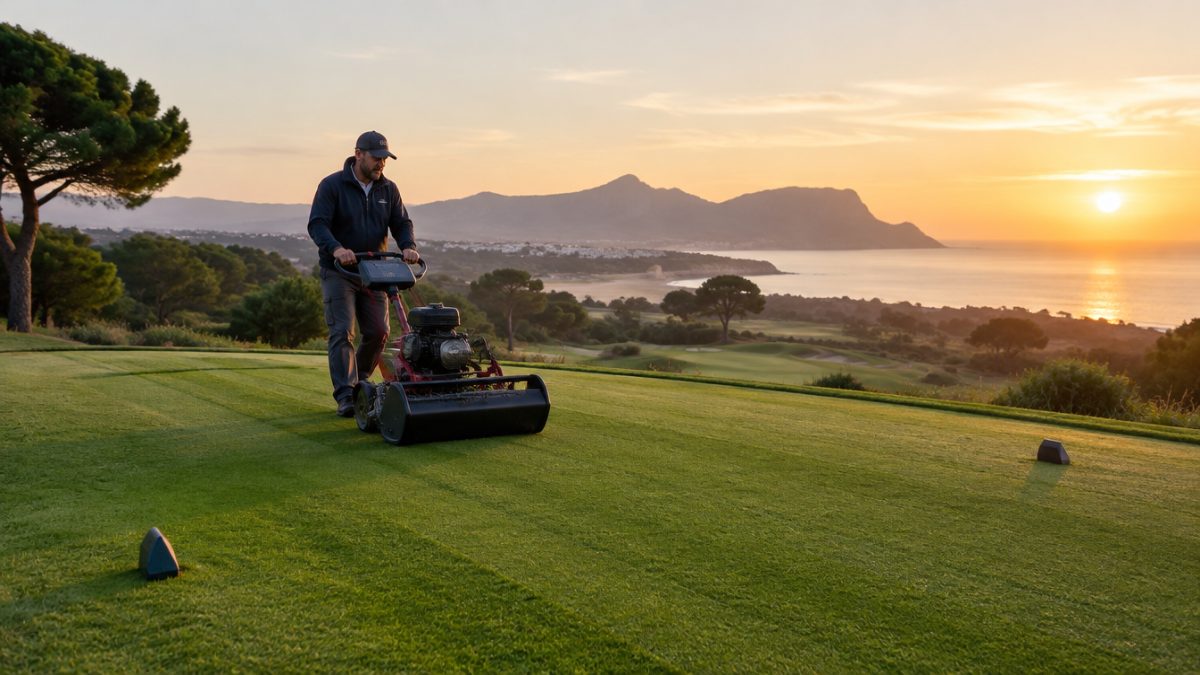
Because tees are small and awkward for machinery to reach, many courses mow them by hand or with compact equipment. It is a good reason to assign the task to experienced people and to record the time each one takes.
It is also worth watching the weight and type of machine: a mower that is too heavy on wet ground marks the turf and compacts it exactly where it is trodden most. On small tee boxes, light equipment and a careful operator are worth more than lots of power.
Nutrition and irrigation to recover the turf faster
Because tee boxes wear faster than they grow, they need a nutrition programme designed for recovery: frequent, moderate inputs in the growing season, with attention to root health and nutrient balance. Too much nitrogen produces soft leaves that are sensitive to wear; a deficit slows repair.
As for irrigation, the ideal is to:
- Irrigate with the frequency and depth needed to keep the soil firm, without waterlogging it.
- Check sprinkler coverage on small tees, where it is easy to fall short or overdo it.
- Pay attention to shaded areas, which dry out less, and exposed ones, which dry out sooner.
In addition, a periodic soil analysis helps detect compaction, pH imbalances or salt build-up that slow recovery without being visible to the naked eye.
Repair divots and overseed systematically
Divots are unavoidable, but they can be controlled. If left unrepaired, the grass loses cover, weeds move in and the tee becomes an uneven patch. A routine of frequent repair keeps the surface in good condition and reduces the need for major interventions.
A reasonable routine includes:
- Filling divots with a mix of sand and seed, matched to the tee’s species.
- Providing players with sand and seed boxes so they repair their own mark, with clear signs.
- Scheduling overseeding or top-dressing in the periods of best germination.
- Temporarily protecting recovering areas with ropes or marker changes.
For overseeding, choosing seeds or varieties suited to the climate and the dominant species avoids incompatible mixes that give an uneven look. And involving the player, with a friendly sign, saves hours of work every week.
Another aspect that is often overlooked is the timing of repairs: doing them just before a period of intense heat or frost means doing them again. Look at the course and species calendar to pick the right date.

Rotate the markers and record what happens on each tee
Moving the tee markers is probably the cheapest and most effective way to spread wear. Always placing them in the same spot concentrates the shots and exhausts the surface; rotating them to a plan spreads the use and lets damaged areas recover.
To get the most out of it:
- Define a rotation scheme by weeks or by days according to traffic.
- Mark the progress of the markers with paint or a reference plan.
- Respect the playing distances and consistency with the course scorecard.
- Communicate the changes to reception staff and starters.
Finally, record what is done on each tee: mowing, fertilising, overseeding, repairs and rotations. With that history you will see which tee boxes demand the most resources, which recover best and where it is worth investing in a rebuild. What is not written down is forgotten, and what is forgotten gets repeated.
Further reading: R&A. The R&A offers guidance and resources on sustainable course management that can serve as a reference when planning your tees.
Frequently asked questions
How often should tee boxes be mown?
During the growing period they are usually mown several times a week, and less when the turf grows more slowly. What matters is maintaining a consistent height, sharp blades and a varied pattern. Each course adjusts the frequency according to the species, the use and the level of service it wants to offer.
How do you prevent wear on tee boxes?
With sufficient surface area, frequent rotation of the markers, quick repair of divots and a nutrition programme designed for recovery. It also helps to educate players to repair their marks and to put up clear signage. If the tee is too small for the traffic it receives, it may need to be enlarged.
Which turf is best for tee boxes?
It depends on the climate and the use. In a Mediterranean climate, warm-season species such as bermudagrass stand out for their recovery capacity, while in cooler areas ryegrass mixes or other species are used. The ideal is to consult a technician and choose a species that fits your maintenance plan.
Keep reading
- how to choose the turf cutting height Mowing height: a complete guide by course zone
- thatch control on golf surfaces Thatch in greens: 6 warning signs and how to reduce it
- winter overseeding step by step Winter overseeding: 6 steps for a green course