
The green that used to roll well now gets waterlogged, dries out in patches and reacts badly to any stress. Often the cause lies below the surface: thatch in greens is the layer of stems, roots and organic debris that builds up between the green leaves and the soil, and when it grows too thick it becomes a silent problem.
This article describes six warning signs that help you detect it in time and reviews the cultural practices used to reduce it and keep it under control. The criteria are general; the intensity of each practice will depend on the species, the climate and your greens’ tolerance.
What thatch in greens is and when it stops being normal
Some organic matter is natural and even beneficial: it cushions ball impact, protects the crown and adds resilience. The problem appears when debris production outpaces decomposition. It happens with very vigorous turf, with excess nitrogen, with acid soils or low microbial activity, and with management that keeps the profile constantly wet.
As a guide, many programmes aim to keep the layer thin, although the acceptable value depends on the species and the use of the green. The important thing is to measure it regularly and not wait for the turf to show serious signs. A good habit is to fix three or four reference greens, with different orientations and levels of shade, and always measure them at the same points: that way the data serves for comparison and not just description. Extract a core with a sampler and look at the profile: when the fibrous layer is spongy, thick and clearly distinct from the soil, it is time to act.
Signs 1 and 2: the green gets waterlogged and dries out in patches
The first symptom is usually related to water. A thick organic layer holds water like a sponge and acts as a barrier to infiltration. You will see persistent puddles after irrigation, areas that stay soft and, at the same time, spots that dry out easily because water does not reach the roots well or because the surface becomes hydrophobic.
If you see either of these situations, do not simply water more or less. Check the soil profile, infiltration and rooting depth. Thatch in greens is often behind erratic water behaviour that no irrigation programme can solve on its own.
Signs 3 and 4: shallow roots and a soft green
When roots only explore the first few centimetres, the turf depends on frequent irrigation and suffers as soon as temperatures rise. When pulling a core, check whether the roots stay in the fibrous layer without penetrating the mineral soil. It is one of the most reliable clues to excess thatch in greens.
The other sign is a spongy feel underfoot: the green gives, ball marks take longer to recover and ball roll is irregular. This is often joined by scalping after mowing, with the blade cutting into the fibrous layer and leaving bare patches. Be especially watchful after periods of intense growth. If several of these signs coincide on the same green, it is very likely that thatch in greens is the underlying factor and not a one-off management failure.
Signs 5 and 6: more disease and less response to fertilisation
Wet organic debris is an ideal refuge for fungi, and thatch in greens increases the risk of outbreaks such as Fusarium or anthracnose. If the same greens get sick at the same times every year, look at the profile before blaming the weather.
The last sign is a poor response to feeding: you apply the usual and the turf barely reacts, because nutrients and water are held in the fibrous layer or do not reach the roots. The opposite can also happen, where after fertilisation the green grows very vigorously and accumulates even more material. In either case, the solution is to act on the layer, not on the fertiliser. Also check the pH and the soil’s biological activity, because a very acid or lifeless profile breaks down debris poorly, whatever the nutrition programme.
How to reduce thatch in greens with cultural practices
The programme usually combines several practices, adjusted to the season and the green’s tolerance:
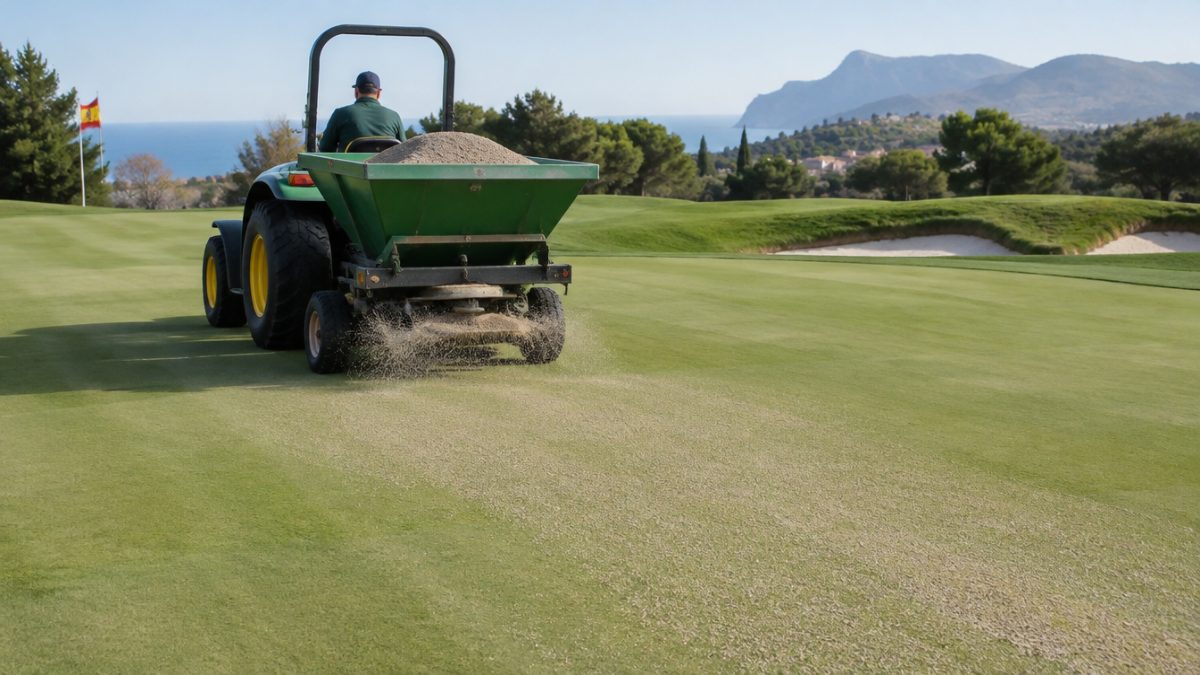
- Frequent, light top-dressing: dilutes the organic matter with sand and encourages decomposition.
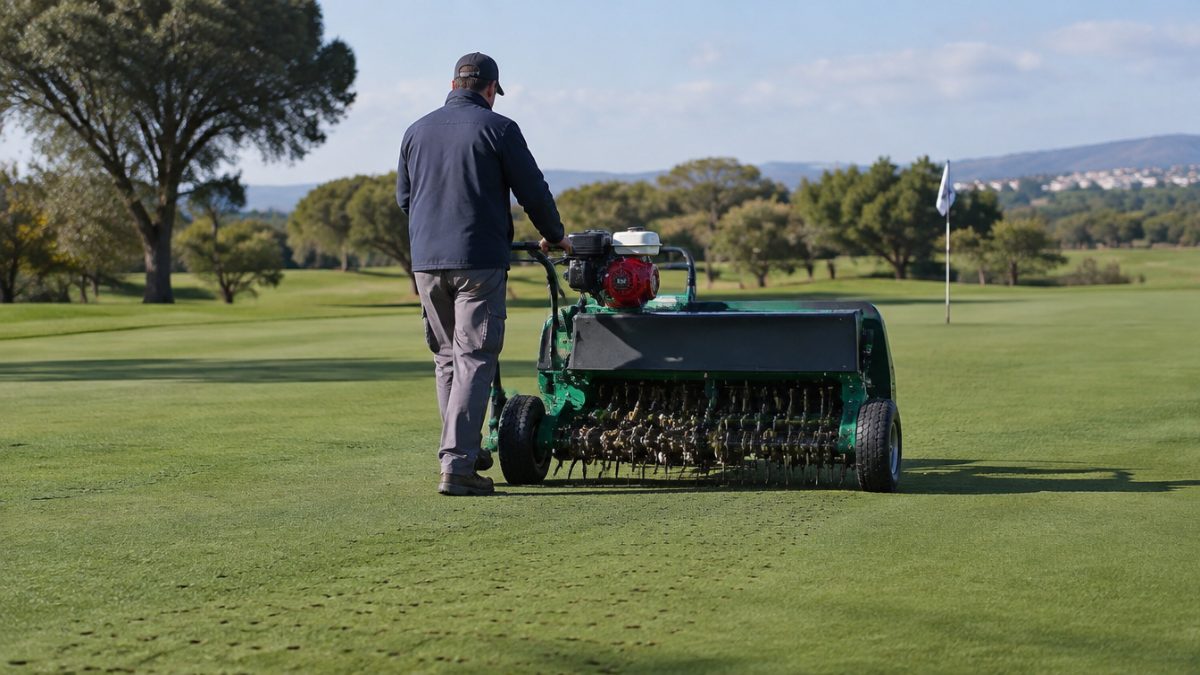
- Aeration: with solid or hollow tines, it opens channels for air and water. Hollow-tine aeration removes material directly.
- Verticutting or scarifying: removes part of the material, always with controlled depth so as not to damage the crown.
- Irrigation and fertilisation management: avoids the excess moisture and nitrogen that feed its production.
Do not try to correct thatch in greens in a single operation. Aggressive interventions disrupt play for weeks and stress the turf. A steady programme with small doses throughout the growing season is better.
Plan, measure and keep a record of every practice
Controlling thatch in greens is a job of years. Measure the thickness of the layer at a fixed interval and at specific points on the green, and record each practice: date, type, depth, area, material applied, equipment hours and later assessment. With that data you can compare which programme gave the best results and which greens respond fastest.
You can also justify to management the time and resources the practices cost, which are sometimes perceived as a nuisance to play. If the club sees a clear improvement, occasional restrictions are better understood and accepted.
Further reading: USGA. To find out more about green management and technical recommendations, you can consult the USGA's resources.
Frequently asked questions
How is thatch in greens measured?
A core is extracted with a sampler, the profile is observed and the thickness of the fibrous layer between the leaves and the mineral soil is measured. It is worth repeating this at several points on the green and on the same dates each year to compare. It is a simple measurement that needs no expensive equipment.
Can thatch in greens be eliminated all at once?
It is not advisable. A very aggressive intervention stresses the turf, disrupts play for weeks and can leave the green exposed to disease. The usual approach is to reduce it gradually with repeated, moderate practices through the growing season, and keep it in check with regular top-dressing.
What role does fertilisation play in thatch in greens?
Excess nitrogen stimulates vigorous growth that produces more debris than the soil can break down, so the layer increases. Adjusting the feeding programme to the soil analysis and the season helps control the problem. Any product must be used according to the label and current regulations.
Keep reading
- Complete guide to turf maintenance on golf courses Complete guide to turf maintenance on golf courses
- Fusarium patch in turf: winter measures Fusarium patch in turf: 5 winter measures
- Benefits of using organic fertilisers on golf courses Benefits of using organic fertilizers on golf courses